
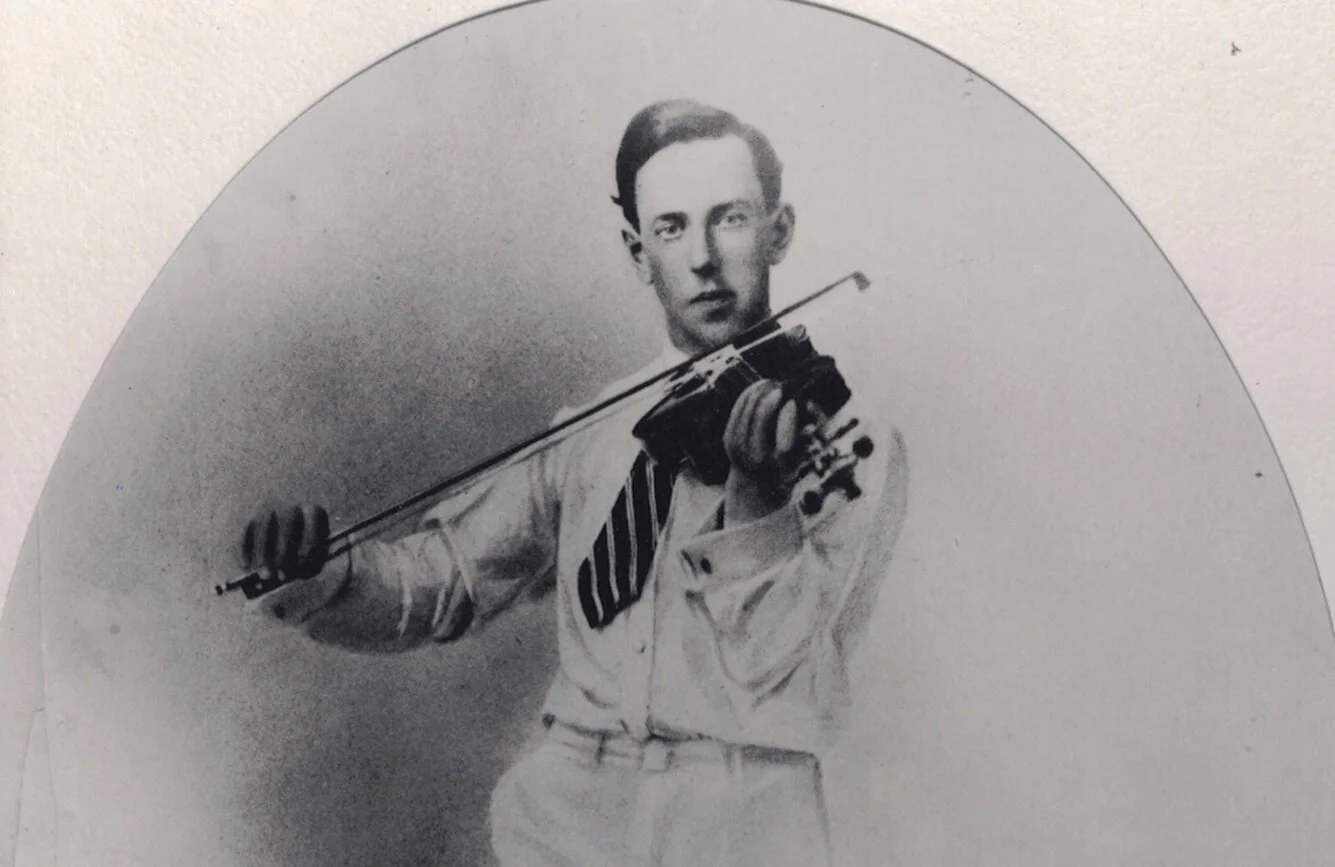
Michael Coleman recorded some of the earliest records with sets starting around 1920.
When we learn Irish trad tunes, the tradition is to combine them into medleys (called sets) of two or more tunes. Sets are the sorcery of Irish sessions to outsiders. To drop into a pub and listen to a scraggly group of musicians play high tempo tunes in unison and then poof! switch to a different tune without a hitch is a thrilling experience for the audience (and often the musicians themselves).
Sets can be based on a famous recording, a tradition at a local session, or entirely of your own invention. There are just a couple faux pas worth mentioning. Don’t repeat a tune that was just played and don’t replace one tune with another in a well known set. Either will likely earn you a cringe from an old-timer. Otherwise creativity is unlimited. For me, the most impressive and fun thing is to experience a musician come up with a brand set on the fly with a mix of common and uncommon tunes. Such a stunt is likely to earn you an exalted “whoop” from one of your seat-mates. I highly recommend mixing uncommon tunes into your sets too. You might have to play that tune alone, which is great practice, but you might also garner smiles and hear afterward the likes of “I haven’t played that in twenty years” or “I love that tune but have never heard anyone play it” or best case “Will you teach me that tune”.
With that bit of enthusiasm, let’s take a look at set mechanics. Each tune in a set gets played a few times, followed by a seamless transition to the next tune. There is no hard rule about how many times each tune gets played. Three seems to be the most common, but slower tunes like hornpipes might default to two. If you play a tune that confounds everyone else, you might even switch to a more common tune after one round. In contrast, if your tune is on fire and you want to play it more, make eye contact with the group and indicate you are going to repeat it. A swell of volume and holding a transition note longer can do the trick. My experience playing at our Tuesday session in Oslo is that keeping a popular tune going a couple more rounds is one of the best ways to make the session exciting and dynamic.
Sets are usually the same type of tune (e.g reels) or mix compatible types like jigs and slip-jigs. The leader of the set uses an audible cue (hupp!) to announce a coming tune change. They might alternatively yell out the next tune's key "A minor!" for accompanists. When you compose a set and home, be aware of the key of each tune. It’s okay to play consecutive tunes in the same key, but changing from a minor to a major or from a G major to a D major often lends the set a nice lift in energy. If consecutive tunes are in the same key, make sure that the feel of the tunes differ, such as a going from a modal to a straight major tune.

Oslo’s own Sound - Irish Dance Factory Pub-takeover, with dancers dancing to a smoking set of reels from band Murray Well at the Dubliner Folk Pub.
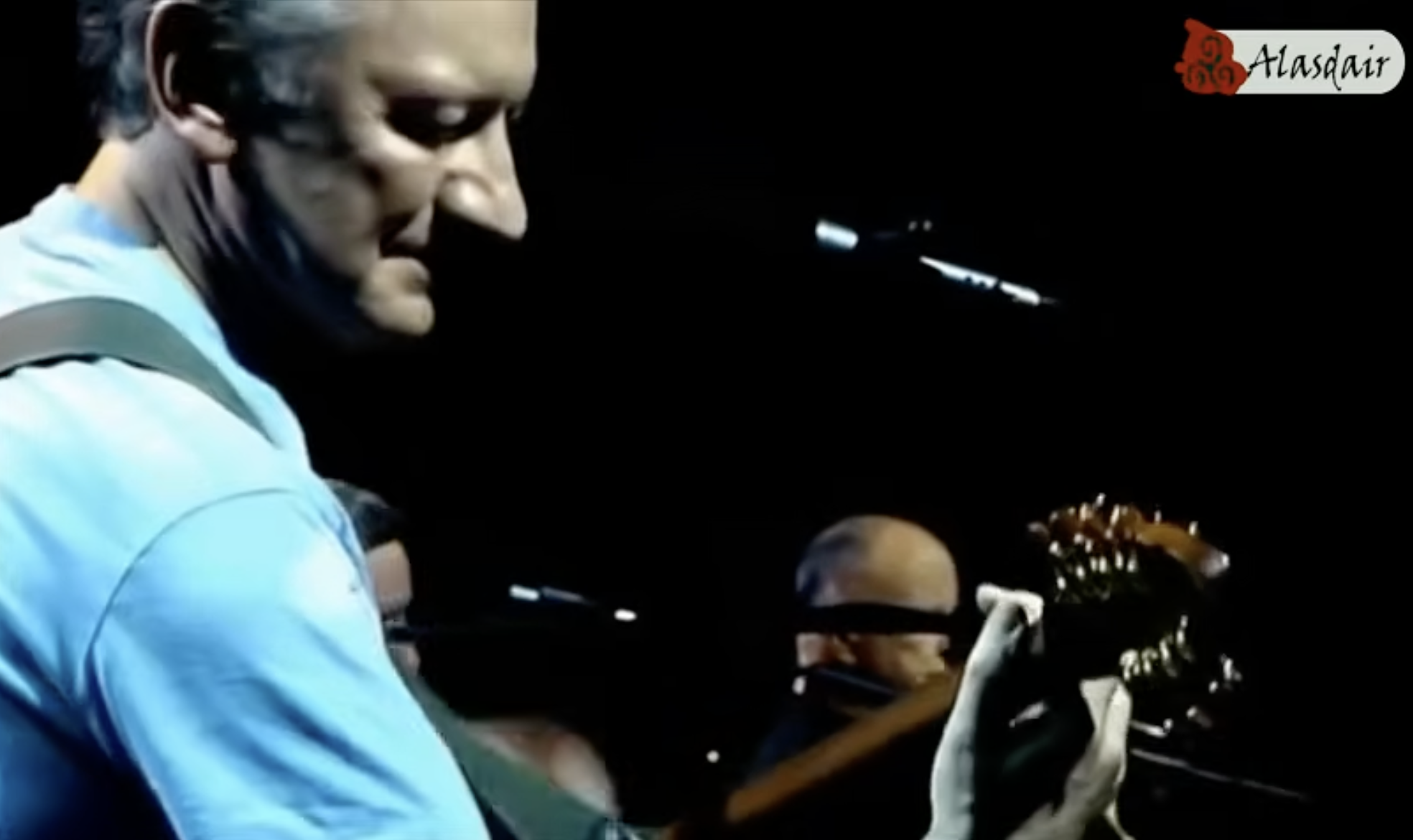
Liam O’Flynn plays a reel set with keys D modal (Jenny’s Wedding), G major (The Virginia), and then G major (Garret Barry’s) again. R.I.P. Planxty member Dónal Lunny, who died last week.
By learning tunes in sets, it eases the challenge of internalizing hundreds of tunes that are part of your session's repertoire. It’s like learning a word in a foreign language by learning them in the context of a song or poem. Tune sets often have a well known history of famous recordings and stories about their author or place of origin, which gives you rich connections to the trad culture and helps to internalize and perform the tunes on an emotional level. Experienced musicians enjoy sharing the stories behind sets, even if it is just part of the lore of your local pub.
Making Tune Set Playlists

In Spotify’s settings, you can include local files. Spotify seems able to read meta information about the artist and album that I tagged the file with in Apple Music. For me, using Apple Music is easiest because it was originally designed for importing music, unlike Spotify.
As ambitious students, many of us are learning a couple tunes from an instructor each week and slowly assembly sets. For each set you create, put the instructor’s recordings into an album in your music software. Many people don't have local audio/video files in apps like Youtube Music, Spotify, or Apple Music anymore because they stream everything. But most software still allows you to upload (Youtube Music), import (Apple Music), or display (Spotify) local files and put them in playlists or albums.
Let's say you have the three tune reel set Over the Moor to Maggie, Fred Finn's, and The Hunter's House, which is a recording on the 2015 album Music at Matt Malloy. Create a digital album in the following format:
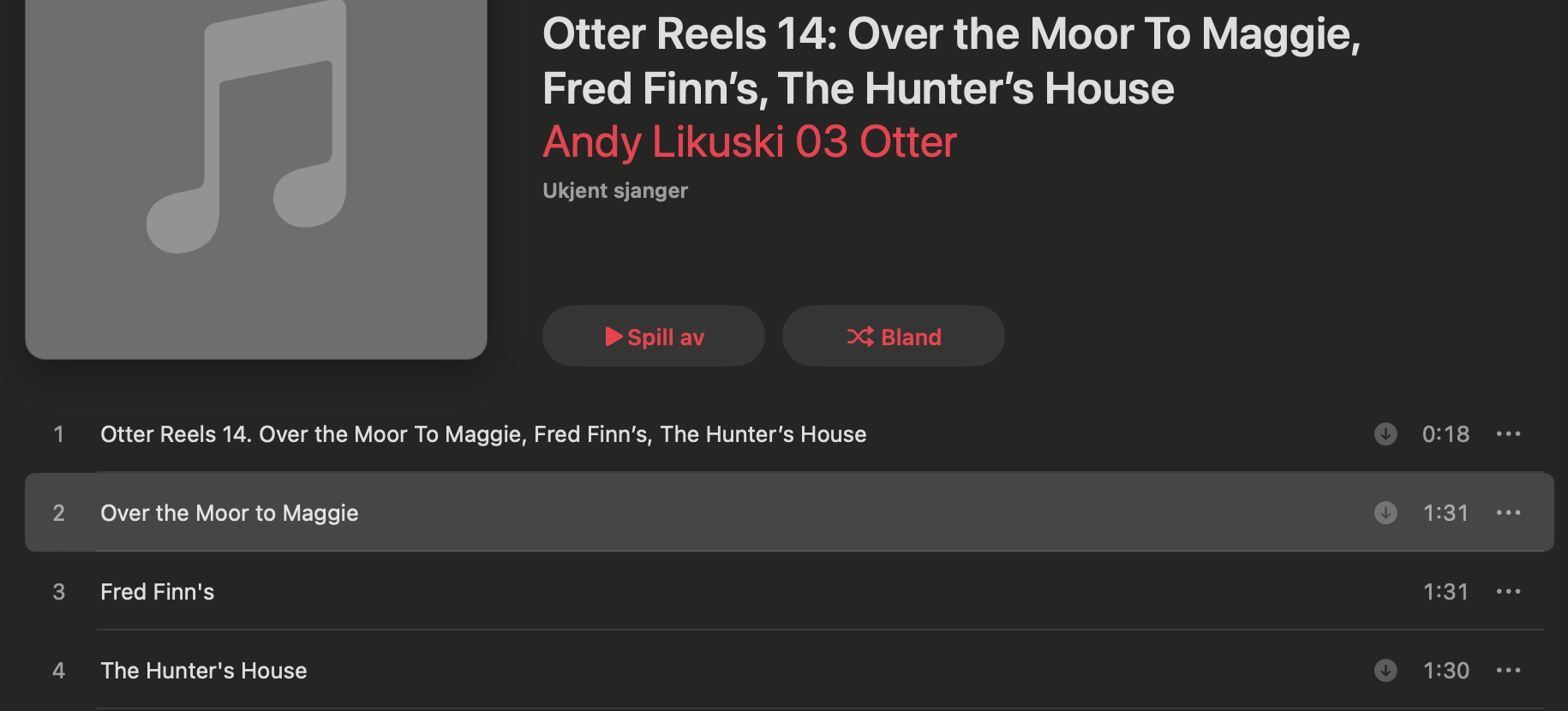
An example album of my instructor recordings. Not the album and artist and name of each track. The numbers 14 and 03 make sure that the album is sorted as the 14th album in the Otter Reel set and the artist is sorted as the 3rd category, which for me is the animal otter.
Album Name: 2026/Otter/Purple Reel Set 14. Over the Moor to Maggie, Fred Finn's, and the Hunter's House
2026/Otter/Purple is how you categorize your sets by year, animal, color, or something else.
07 means it's the 7th reel set in that category. Use 07 instead of 7 so album sorting works correctly.
Artist Name: Your Name 2026/03 Otter/03 Purple
Name the artist yourself and use the category again. (Put a number in front of the category if it’s not a year so that the category sorts chronologically)
Tracks:
Track 1: Record a voice memo/sound file where you say the following 3 things:
Say the Album Name: 2026/Otter/Purple Reel Set 7, Over the Moor to Maggie, Fred Finn's, and the Hunter's House
Your Association with the set: Set from the album Music at Matt Malloys
Tune Names with Pauses: Over the Moor to Maggie (5 second pause), Fred Finn's (5 second pause) , The Hunter's House (5 second pause).
Track 2: Instructor Recording of Over the Moor to Maggie
Track 3: Instructor Recording of Fred Finn's
Track 4: Instructor Recording of The Hunter's House
Make an album for each of your sets. Now when you play back, you'll first hear your own voice saying the first track, followed by each track as played by your instructor. This system is a bit of work to set up, but the benefit is that you can listen to your learned sets in order and be reminded of their name, order, and tune type before hearing your instructor play them.
Listening Exercises
As you listen to your sets over and over everywhere you go, do the following exercises:

Homer becomes an avid listener of Lisa’s favorites to win favor.
Can you generally hear the next line coming in each tune? If not, you might not have learned the tune well yet. If your instructor plays certain notes or phrases differently than you remember, make a mental or physical note to replay that tune next time you have your instrument out and find the discrepancy. You can optionally add the set to your Lousy List (described below).
Even if you are just listening casually, see if you notice ornamentation that your instructor recorded that you have forgotten to imitate. Some instructors play with a lot of ornamentation, and you don't need to match every one of them, but you might want to remember the most effective ones.
When a new set is starting, and you hear yourself on the first track each tune name, such as "Over the Moor to Maggie" followed by a 5 second pause, use the pause to try to remember how that tune starts. Do the same thing with the other tunes of the set.
If you hear an old set that you feel you've got down pat, either skip it or listen carefully for things you might have missed, especially your instructor's faster recording that might have some variations you want to work into your playing.
If a tune plays that you don't recognize, despite having just heard the name said, take a quick look at your screen to get the name and set and think about why you don't recognize the tune. Have you not played it lately? Does it confuse you by reminding you of other tunes? By thinking through this, you'll have a better chance of remembering it later.
How to Practice All Those Sets
Consider having different practice queues and choose which queue to tackle depending on your mood:
New: New sets should always take priority. Start with this week's new set(s) and then go backwards a few weeks.
Lousy List: Practice sets that you struggled with at a session or noted while listening to your instructor recordings. I call this my lousy list, but you can come up with a more positive name :)
All: Go through all your sets in order, marking down the place you end your practice each time. You can use the bookmark system we discussed in the post "Learning Songs (And Actually Practicing Them)". I recommend going through sets by category (e.g. 2026 tunes) and then by tune type, so you’ll spend a lot of time playing the same tune type.
Whim: Play whatever sets comes into your head on a whim! If you wake up humming a tune, figure out what set it is in an practice that set!
Whenever you practice a set, mark the date you practiced, the tempo of the backing track or metronome, and give yourself a grade. You can either mark it in your tune set list or on each tune set’s practice sheet (see the post "Learning and Reviewing Tunes"). It might take months to go through the All queue, especially since you are constantly adding new sets. But when you get to the end and start over, you will find next time you are able to get through all the sets faster and faster as you improve on your instrument and your tune recollection.
Practicing Tune Transitions
Besides remembering all the tunes in a set, we also need to practice transitioning smoothly from one tune to the next. Make sure to play with backing tracks of your tune sets (Strum Machine makes it easy to put tunes into a medley) or use a metronome.
Play the first tune several times and then the beginning of the next tune.
If you transition to the next tune cleanly, skip to step 4.
If you don't, pause the backing track or metronome and practice the transition, noting what note the new tune starts on and how to move to that note from the previous tune. Then restart the backing track or metronome, playing from the last section of the previous tune and try to transition cleanly.
If you are using a tune set practice sheet, consider writing down the ending note of one tune and the starting note of the end tune. The second tune might have intro notes that modify or cut off the end of the previous tune. I like to write these to the left of the line that separates the two tunes on my sheet.
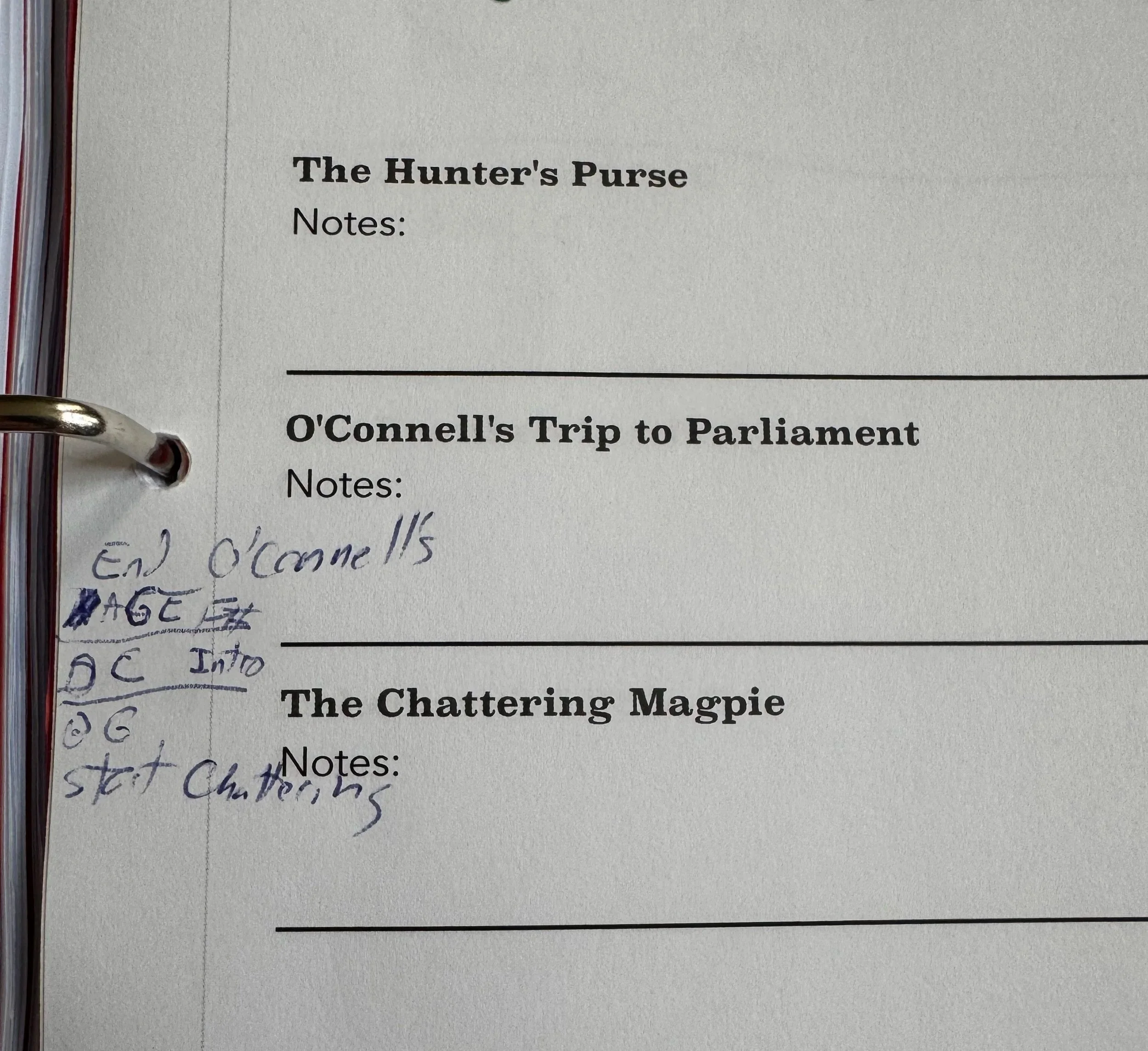
I put transition notes in my tune set practice sheet.
Example:
End O’Connell’s Trip to Parliament with: A’ G’ E’ F#’ (‘ indicates the high octave)
Transition Notes: D’ C’
Start The Chattering Magpie with B G
You could alternatively write the transition as sheet music. Do whatever works, but only write notes if you have trouble playing the transition.
Remember. If you can't transition smoothly whilst practicing, you'll never pull it off in a session! Making smooth transitions under pressure in a session is the sign of a great musician. You are dealing with various instruments playing, pub noise, and the danger of forgetting your next tune or at least the intro notes, so take this task seriously. When I hear professionals and advanced amateurs make transitions, it seems like they are so locked into the sound of each tune that no distraction phases them.
Conclusion
To conclude, our goal is to be effective with tune sets. We want to organize our instructor recordings into audio albums that remind us about each tune. We want to listen to those albums when we are going around town to solidify our memory and recall of each tune. Finally, we want to have practice queues so we practice sets regularly and master tune transitions within each set.
Tune sets are one of the most special and magical aspects about playing Irish trad. It leads to the tremendous satisfaction of playing for five or ten minutes straight in a session, at home, or maybe even for dancers, and it’s a great triumph when you manage to lead a set effectively and get a nod of respect out of the old-timers.
—Andy Likuski