
Song practice begins with careful organization. It's great fun to turn randomly to a page or play whatever comes to mind, and I highly recommend it. Beyond that, we need a comprehensive method for learning and practicing every song in your ever expanding repertoire. Here is where your song repertoire and song practice sheets come into play.
Song Repertoire
Your song repertoire consists of 3 🔖 Bookmarks that navigate you to somewhere in each of three lists, our old traffic light buddies
🟢 Green Song List Songs you are more or less ready to perform
🟡 Yellow Song List Songs that you have learned but need work to make them performance ready
🔴 Red Song List Songs you want to learn.
Bookmarks are simply local links to where you are currently practiing in each of the three lists. We are going to work through each list in parallel like three little snails each eating their way through an ever-growing garden row of delicious plants:
🟢 C 🍏→ 🔖🐌→ 🍐 →C waltzes 🫛→🥬→ G 🥒 𝄇
🟡 Amin 🍋→🌽→🍌→🔖🐌→Emin🍍 𝄇
🔴 A 🍎 →🔖🐌→🍅→E 🍓→🍒 𝄇
Your three lists will be sub-categorized by the key of the song.
You move the bookmarks as you practice.
𝄇 Means repeat forever!
If we get to the end of any list we simply reset the bookmark target to the start of the list. Naturally, yellow songs should move to green and red songs should move to yellow or green after you practice them. Since you are always adding new red songs you want to learn, both lists will always have new material to cycle through.
Here are instructions for creating a bookmark and a link to that bookmark with Google Docs, Microsoft Word, and Apple Pages. If you’re using anything else, search the internet for “create and link to a bookmark within X document” where X is your document type. When you click on one in your document, it will scroll you down to the current place in the list. In this case we’ve manually moved the bookmark to song in the C Waltzes section, so clicking on Green above would scroll us there.
Bookmark links might look like this. Clicking Green scrolls you down to Green Bookmark below. Try it!
(Disclaimer: The use of cheesy pub songs below is intentional. I hope you have a better repertoire!)
🟢 Green Songs
C Major
1) Whiskey in the Jar
2026-09-20 (date that you last practiced the song)
The Dubliners in C (the version of the song you are copying and the key they used)
2) Marie’s Wedding
2026-10-02
The Clancy Brothers in E
3) Wild Mountain Thyme
2026-10-08
Liam Clancy in D
….
C Major Waltzes
1) Black Velvet Band
2026-10-09
The Dubliners in G
2) Down in the Willow Garden (the current green song you are practicing)
Dan Tyminski in G
3) Molly Malone
…
G Major
….lots more songs in different keys….
🟡 Yellow Songs
(same format as green songs)
The current yellow song you are practicing
🔴 Red Songs
(same format as green songs)
The current red song you are practicing
Why Sort Your Lists by Key?
We want to sort by key so that we get a long stretch of practicing our instrument in the same key. This might seem unintuitive if you play a guitar and capo, but even if you are playing the same guitar patterns to play in G and B major, it’s important to listen when you are playing in B and think to yourself, ”I, IV, V chords are B, E, F# in this key, and when I play note positions 3, 2, 1, I’m playing D#, C#, B”. Maybe you want to try playing in B without a capo at some point to get more mastery of your guitar. In non-capo instruments, practicing the same key for a long time is the best way to learn a key you are weak in. Even if you don’t play an instrument, we want to practice singing in the same key for a long time so that we get to know our vocal ranges in each key and maybe think about what notes we are singing. If you sing in D, for instance, learning that your 3 note is an F# and what that feels like to sing in your range is useful data.
All songs in this list should be categorized by the key you sing the song in. It's easy to move the song to a new category if you decide to change your key.
Song Practice Sheets
Each song practice sheet is your treasure map to getting to learn, practice, and eventually perform a song in public. The practice sheet has two pages. The second (back) page is the song lyrics, as we discussed in great detail last post. The first page (front) side tells us everything else we need to know. I happen to use an Apple Pages template for song practice sheets. Here’s a link to my Pages version as well as a Google Docs version, which can be saved as a Word document.
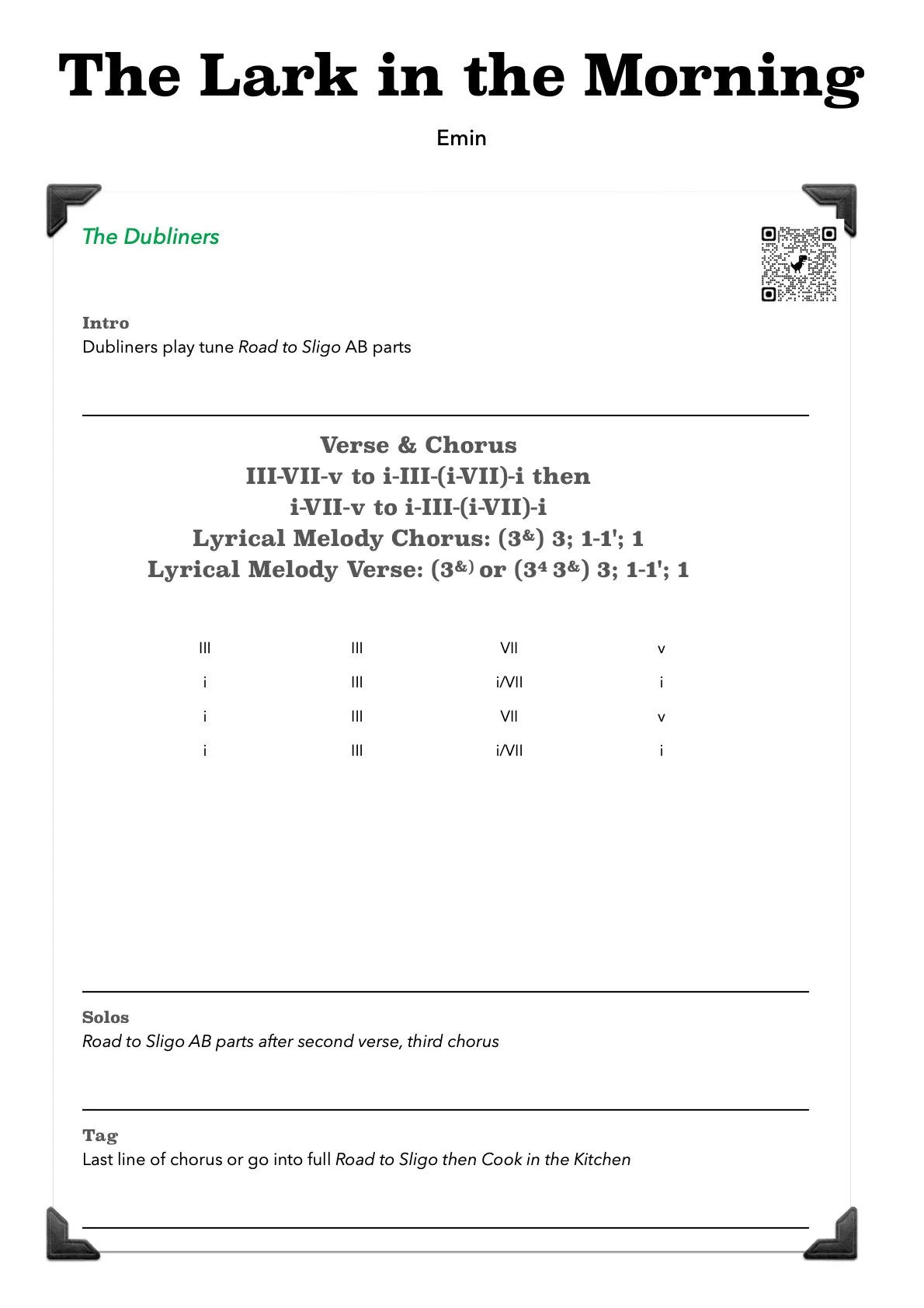
The left side page above of this Lark in the Morning song practice sheet gives an example of everything we want on the first page.
The title of Song
The key you will likely sing in (you can always change it)
The performer(s) you associate with the song
A link to a backing track via a QR code and/or clickable link
Verse & Chorus section(s). Separate this into two full sections if the chorus has a different chord progression (see the next example below for a separate verse & chorus)
The chord progression pattern for verse and chorus (the roman numerals)
The lyrical melodic range for the verse and chorus, meaning what range of notes you are singing (see Finding Your Melodic Range below)
The full chord progression in the table for verse and chorus
Optionally information about the intro, solos, and tag. This could be notes about what you want to play or reference recordings by other artists that you want to copy
Finding the Melodic Range
In order to become more familiar with the song's melodic style, it's important to write down the melodic range of the song’s verse and its optional chorus on your song practice sheet. This goes right below the chord progression summary. We'll use the Appalachian murder ballad Down in the Willow Garden waltz (¾ time) as a first example.
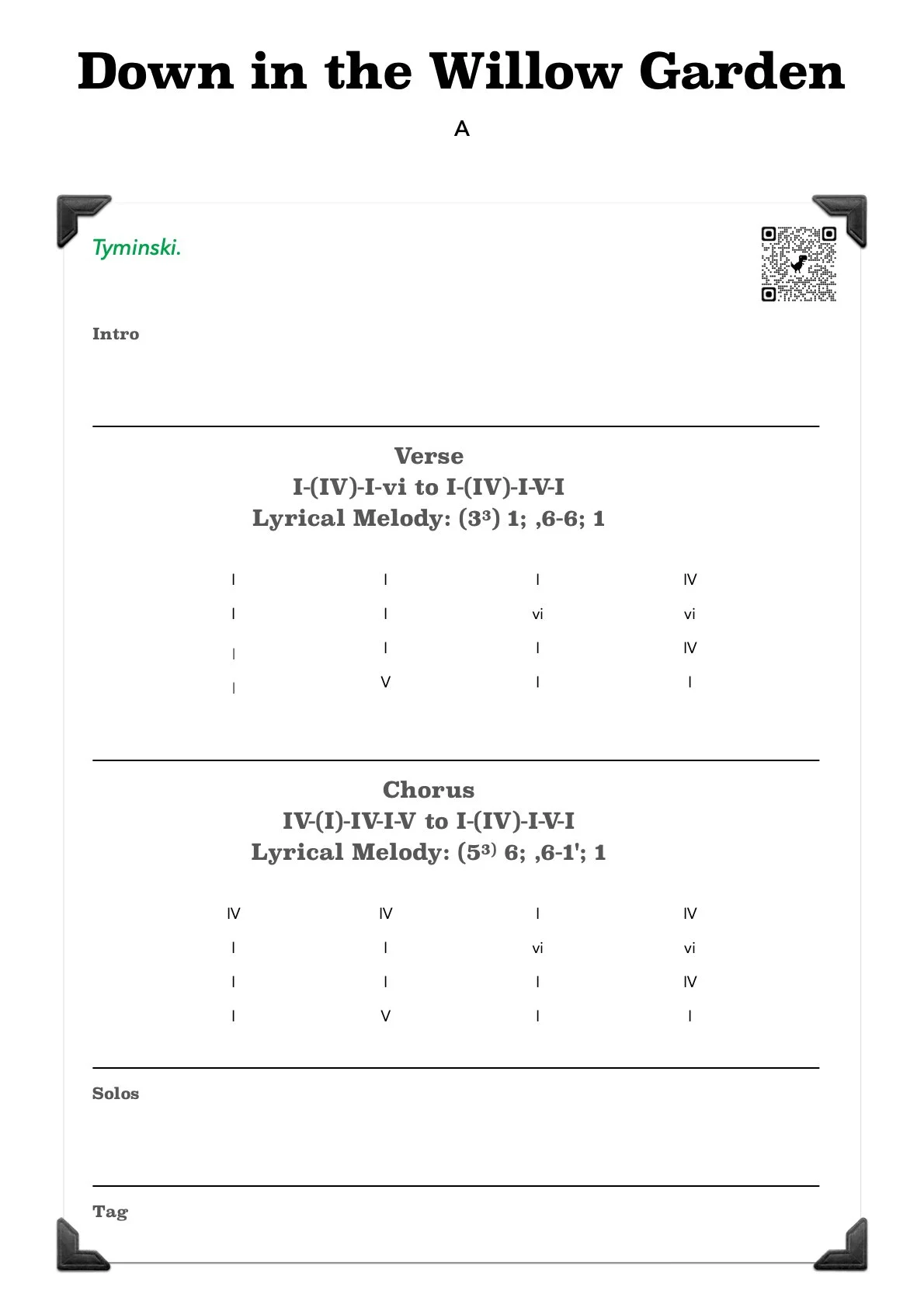
Note the two lines that say Lyrical Melody above.
The chorus lyrical melody (5<sup>3</sup>) 6; ,6-1'; 1 means that in the key of G the melody starts on the 6 after a pickup note on the 5, E, ranges from E to a high G, and ends back on the main G. Whether the main G is a G3 (below the middle C on the piano) or a G4 (above the middle C on the piano depends on your vocal range). Learning to hear the melodic range of a song takes some practice. I’d recommend you grab an instrument that know and try to imitate the pickup notes into the start of the verse. The verse might start right at the beginning of a measure or might have some pickup notes before the first full measure (see The Lark in the Morning example below). Next, try to find the lowest and highest note that is sung in the whole verse. The final note is normally the 1. If you aren’t familiar with any instrument, you can sing along and use a tuning app to find out what notes you are singing. After you figure out the melodic range of the verse, do the same with the chorus if there is a chorus and the melody is different than the verse.
The verse and chorus have the same melody, but the lyrical melody of the final verse has different pickup notes.
The reason we want to write down the melodic range is because we want to both understand what range of notes we are singing and what notes we are building a simple instrumental solo around. To play an instrumental, we may know a song’s melody very well, but when it comes to actually hitting the right notes to start playing, we really need to know what chord tone of the first chord we are starting on. In the case of The Lark in the Morning, it is simply the 3 note on the & of 4, as we discussed above. With this grounding and knowledge of the melody range and ending notes, we are in good shape to put together a simple instrumental. If we don’t have this guidance, we could easily start the instrumental on the wrong note and play an awkward sequence of notes that is a harmony of the actual melody. I do this all the time at sessions, and it drives me crazy that I heard the starting melody note wrong and need to get to the correct melody notes after I started my solo elsewhere.
Chords
The song practice sheet gives a full chart of the song’s chord progression in a table. Each roman numeral represents a chord. We typically see major chords I, IV, and V and minor chords ii, iii, and vi, but there are numerous exceptions. In our chord progression table, each roman numeral represents two beats of a 4/4 song and three beats of a ¾ song. Thus we occasionally use a / if there is one chord per beat, like i/VII above, meaning start with the minor i chord (Emin here) and go to the VII chord (D here). If this is all Greek to you, you can learn about the roman numeral chord system here or browse the internet for other tutorials. The song practice sheet also has a summary of the chord progression written under Verse and Chorus above. This is completely optional, but it might be useful for quickly identifying the chord pattern of the song.
The Intro, Solos, & Tag
The Lark in the Morning is a 4/4 song. However the intro and solo used by The Dubliners is a 6/8 jig Trip to Sligo (sometimes called The Lark in the Morning, which is probably why the Dubliners used it). Irish songs don’t always mix in a tune, but the practice is somewhat common after Liam O’Flynn played Tabhair Dom Do Lamh after Raggle Taggle Gypsy. It’s common to have no intro or instrumental break at all or to simply play the melody of the song.
Song Ground Truthing
Once you have a song practice sheet saved and optionally printed, begin to practice the song. Check for the following.
Is the key optimal for your voice? If not, experiment to find the write key and then change it in the file and simply cross it out and replace it on the optional printout.
Study the chord progression pattern to internalize what type of song you are singing chord-wise.
Play through the song's chord progression and sing. If anything sounds wrong, fix the file and make a note in the printout. Make the same fix in the Strum Machine or other backing track file.
Make sure the lyrics are correct according to the performer you are emulating. If not, fix them in the file and make a note in the printout.
If you can sing through the song and play chords, and everything seems pretty decent, you are done ground-truthing. Print out a new copy of the song practice sheet if you made major changes.
Go to your song repertoire and add or move this song to be under the correct key.
Conclusion
You now have a guide for creating an organized set of repertoire lists (green, yellow, and red) that you practice sequentially. You also have a template to make a song practice sheet for each song you want to learn, practice, and perform. I know this is a lot of work, I’ve done it myself! My aim is for you to have an effective practice for practicing everything you want to be able to sing in a session, band, or just in your car. We want to go from chaotic practice to efficient practice. I’ve learned after years of the former that the latter is much more fun and satisfying.
—Andy Likuski