
Memorizing Lyrics
Christy Moore sings Raggle Taggle Gypsy during the Planxty Reuion show at Vicar Street in 2004.
Singing from memory is mandatory for the serious musician. We need to internalize lyrics along with the style of delivery. Imagine a Dolores Keane, Mary Black, Christy Moore, Paul Brady, Andy Irvine or other folk legends like Bob Dylan or Johnny Cash squinting at a music stand while they poured their hearts out! And yes, agreed, there’s nothing less elegant than someone whipping out their smartphone and reading off a tiny screen and scrolling while they attempt to sing, play a guitar, and interact with other musicians at a session!
Unless you are trying to fulfill a very special request from the audience, where you know the song well but not all the lyrics, you should not read the lyrics (or chords) of a song you are performing at a session. If you just need to check one lyric, there’s nothing wrong with discretely glancing at your phone a few minutes before you sing. If you need to check multiple lines, review the lyrics at home and save the song until next week. I know some people are dreadfully intimidated by memorizing, especially in a non-native language. So let’s learn how to memorize in a fun, habit forming way. Your shower will thank you for all the new songs!
When learning a song, I like to separate myself from the printed lyrics as quickly as possible so that I can concentrate on my vocal delivery of a song and my instrumental accompaniment. Our song practice sheet, which we’ll discuss in the next blog post, is two-sided. The first page is dedicated to instrumentation like chords and the melodic range of each part. The second page (the back side when printed) of your song practice sheet is dedicated to the lyrics used by your favorite artist. It’s purposely on the back side of the page because you shouldn’t need it very often once you memorize the song and your delivery of the song.
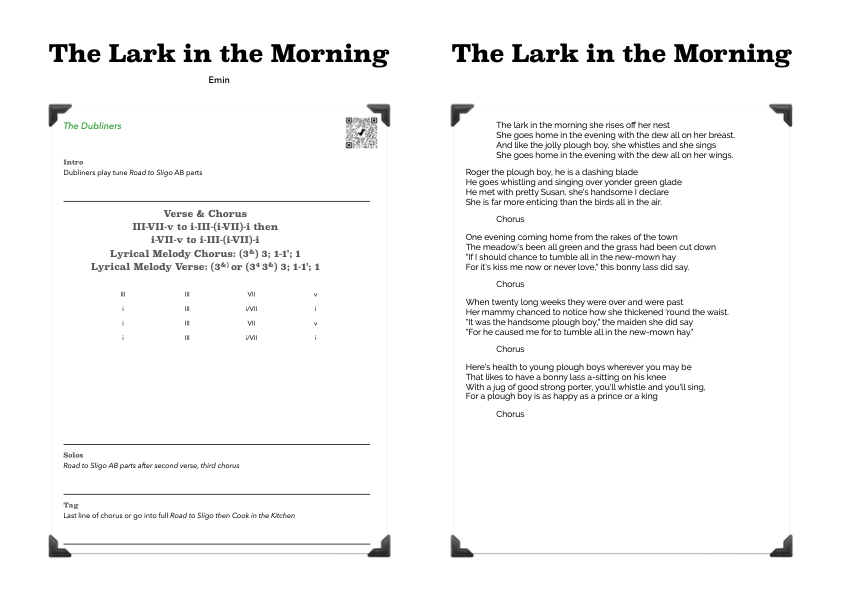
A song practice sheet, which we’ll cover in detail next week. This week we’re looking at just lyrics.
Here is my procedure for learning and memorizing lyrics. Listen to your favorite artist's recording and find matching lyrics online or transcribe the lyrics. Make sure every line is correct. If you find discrepancies, correct them on your practice sheet. If you are singing your own song, you hopefully have them correct, but give yourself to permission to change them if they don’t work out during
Markings
Now here's where the fun starts. Using a pencil on the paper or a software sketching tool that allows annotating a pdf or text file. We're going to create a shorthand symbol system for marking the way the singer sings each line. I have no doubt that there are official systems for marking lyric intonations, but you can very quickly create a shorthand notation system that suits your needs.

A young Bob Dylan idolized Woody Guthrie and visited him in the hospital regularly until Guthrie died.
We want to understand how the singer sings each line and copy as much of their style as possible when we sing the song from memory. This isn't to be a copycat; it's to teach you the vocal techniques they use so that you can develop your own style of singing with a bag of tricks from many different artists. Many great performers begin by copying someone else and then develop their own style. A young Bob Dylan was obsessed with Woodie Guthrie, visiting him regularly in a state institution when Guthrie was withering away from Huntington’s disease. Guthrie greatly influenced a young Dylan, but the latter nevertheless created his own legendary style.
I'll use the ubiquitous campfire song "Wagon Wheel" written and performed by Old Crow Medicine Show (the chorus was based on some incomplete Bob Dylan lyrics.) This is an Americana song that finds its way into far too many pub concerts and perhaps even some Irish song sessions, but the original is a proper folk song. We'll use it since most people have heard it before. When you are learning certain English- or Celtic-language singing styles, you will find more complex vocalizations that require more symbols than I'm using here. You can see the complete lyrics here. Below we'll break each section down and I'll mark by hand.
My Notation
Underlines: My notation system uses lines below words or phrases to indicate syllables that are sung quicker than they would be if read as a sentence, such as "Headed down" below. Sometimes these indicate syllables sung as an eight note triple instead of straight 8th notes. If the grouped syllables extend beyond a line, I use line bookends, like in "Raleigh I can see" below. If a syllable is drawn out when sung, I extend the underline beyond the word, like in "night" of "tonight" below.
Overhead lines: I use a straight overhead line to indicate extra emphasis on a syllable, such as "North" below. I use curves to indicate the voice going up or down, like in "pines" below. For more unusual vocal technique, I simply write a note, such as "falsetto" below to indicate the singer breaking into falsetto.
Midline marks: I use commas to indicate a pause in between syllable or words that is not already marked with a comma. I use a | between syllables or within a syllable to indicate a pause within a word that isn't present when reading the text.
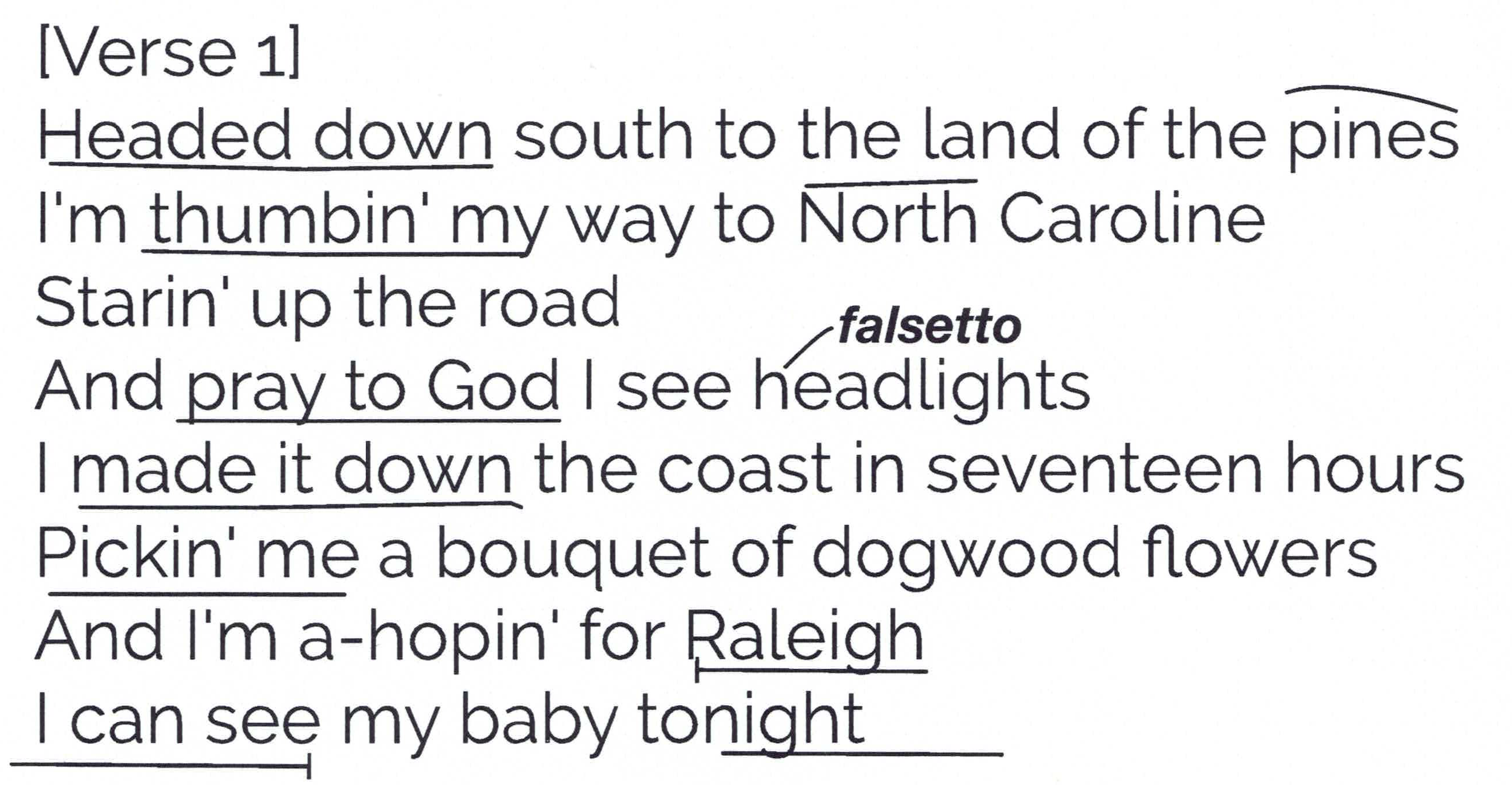
Line 1: "Headed down" is underlined to indicate the quickness that it is sung, since it is sung as an eight note triplet hea-ded-down (trip-pel-let or 1-e-a) instead of straight eight notes head-ded down (1-and-2). The word pines is emphasized and then trails off, hence the curved line above.
Line 2: "thumbin my" is a triplet. North is emphasized.
Line 4: "pray to God" is a triplet. "headlights" has falsetto in the first syllable
Line 5 "made it down" is a triplet
Line 6 "Pickin' me" is a triplet.
Lines 7, 8 In "Raleigh I can see" is sung straight from line 7 to 8 with no pause. "tonight" is elongated to bring us in the chorus.
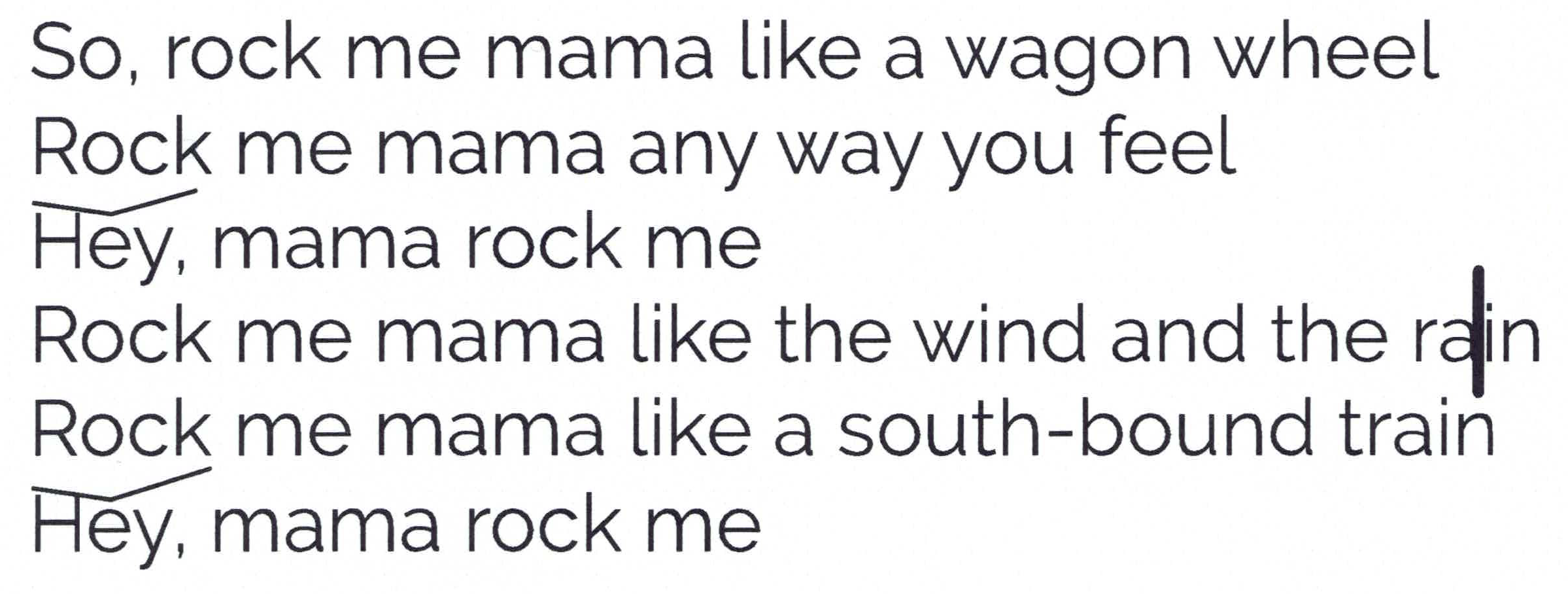
Lines 3, 6: "Hey is inflected down before going up"
Line 5: "rain" is treated as two syllables rai-een
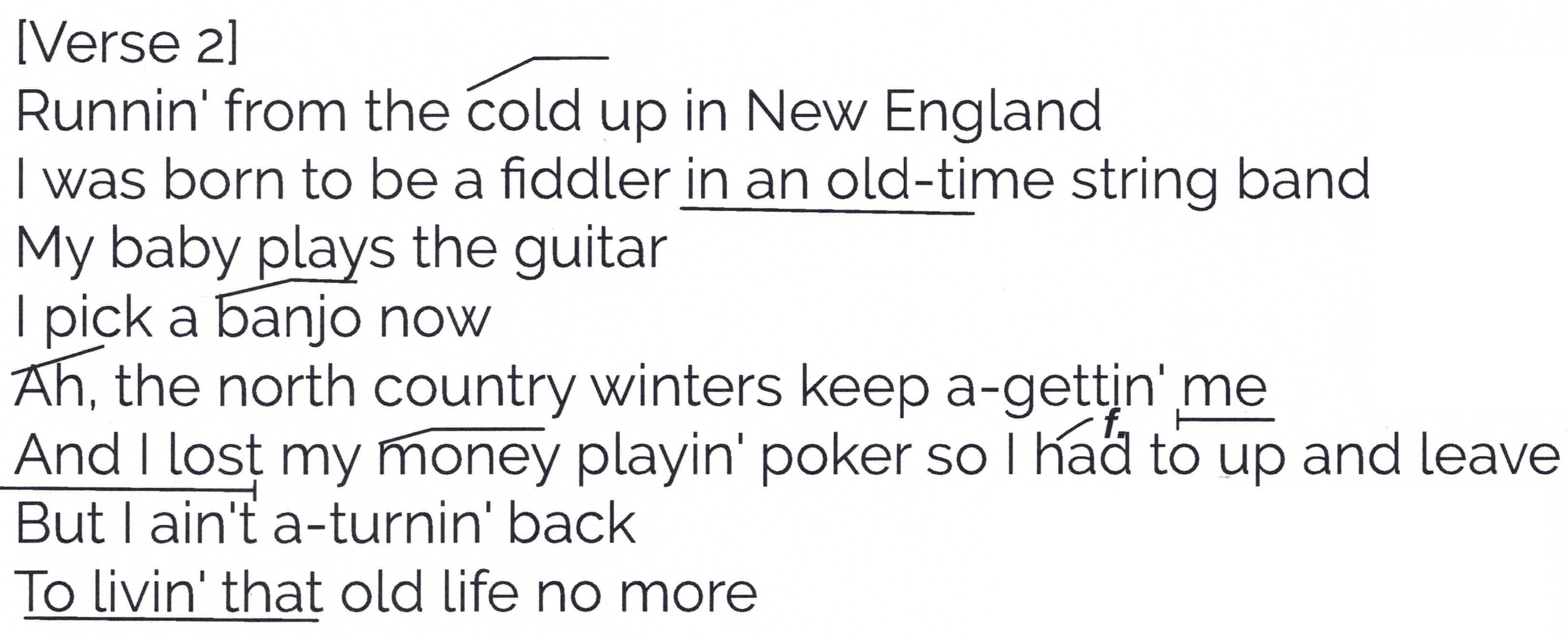
Line 1: "cold is inflected up before steadying" and is held long. Holding long is normally indicated by an underline, but here it's connected to the inflection, so I write it above.
Line 2: "in an old" is a triple.
Line 4: "banjo" is inflected up and then steadies.
Line 5: "Ah" inflects up
Lines: 5, 6: "me And I lost" are connected without a pause between lines". f over "had" indicates falsetto.
Line 8: "To livin' that" is compressed into a triplet to-livin-that, where livin is treated as a single syllable.
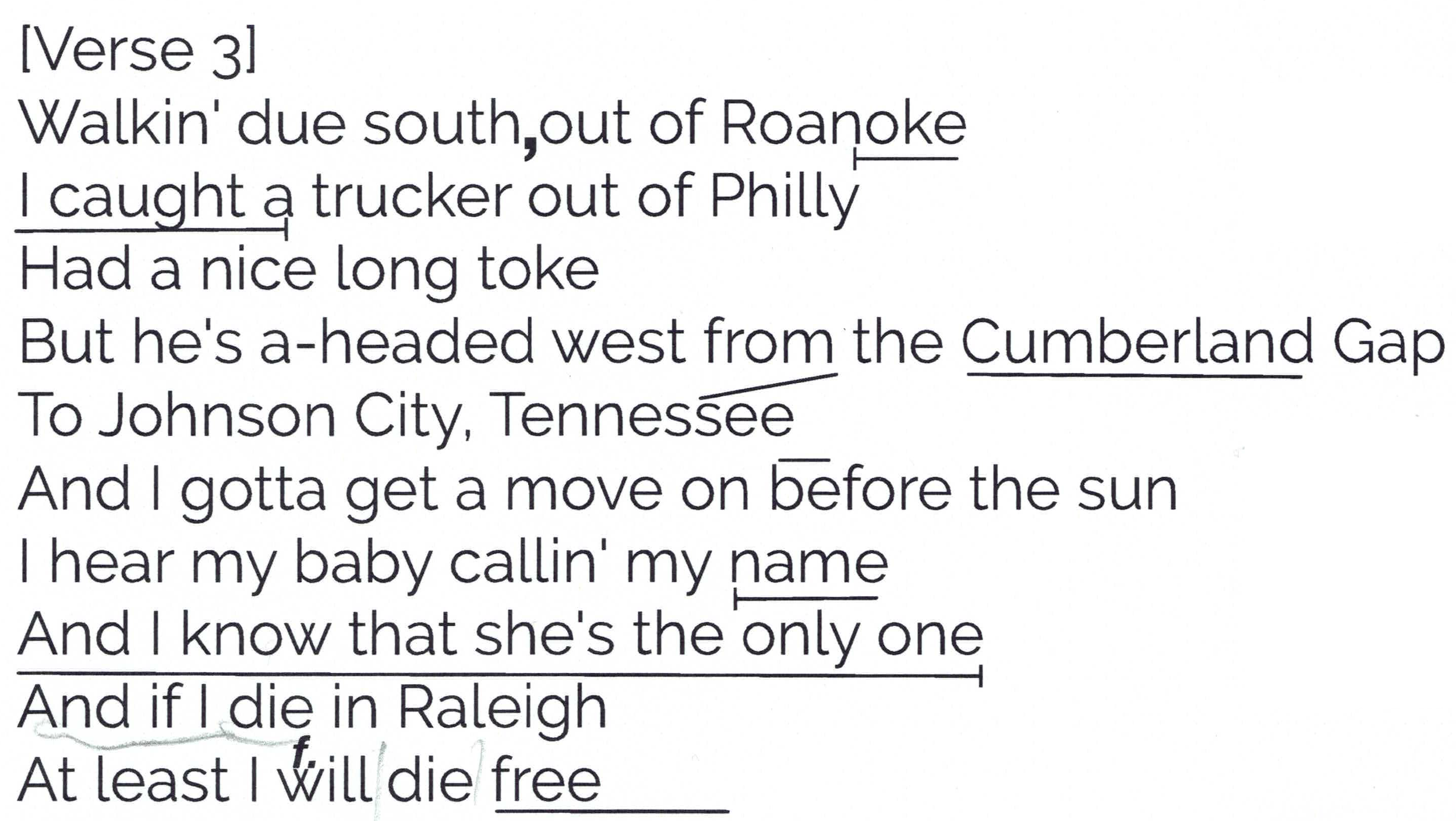
Line 1: a comma is inserted between "south" and "out" to indicate a pause.
Lines 1, 2: "-noke I caught" is connected without a pause between lines
Line 4: "Cumberland" is a triplet
Line 5: "-see" goes inflects up and sustains
Line 6: "be-" if emphasized
Lines, 7, 8: "name" is connected with all of line 8 as to make the sound of consecutive triplets: "name-And-I" "know-that-she's" "the-only" "one"
Line 9 "And if I die" is somewhat quick, but there's not triplet
Line 10 "f over "will" indicates falsetto''. "will die free" is sung as quarter notes to slow down the line. "free" is extended to lead us back into the chorus.
You might not agree with the way I marked the lyrics. Feel free to interpret the song as you'd like to make your own notation system. Make it an organic process but try to be consistent about what marking means what.
After you've marked up the text, practice singing the text several times, both along to the recording that you are emulating and alone. See that all your markings correspond to something about the singing style that you need to remember. If you marked anything incorrectly or need a different symbol or text to convey what the singer is doing, make the changes as needed. Since we're going to memorize the song next, don't spend too much time practicing the lyrics by reading them.
Visuals
Now for some more fun. We're going to doodle a visual next to each line of the text to help us memorize the text. By doodling something that represents the text, you help your mind form visualizations about each line of each verse and the chorus (if there is a chorus). Continuing the Wagon Wheel example, I made little sketches of each line, such as an arrow pointing at pine trees with the cardinal direction letter S indicating "Headed down south to the land of the pines". I quickly created a doodle for every line using a pencil, except for lines that didn't need them, like "Rock me momma anyway you feel", because I've heard this chorus so many times I can't imagine forgetting that line. Be creative with your doodles, but do them quickly. Use color if it helps and doesn’t slow you down. It's not guaranteed that you will ever even look at all of these doodles, but the point is to do the exercise to get your brain to take some kind of mental snapshot of each line. Tip: If your verses are more than four lines each, you might want to split your doodles up with a horizontal line and label verse halves 1a, 1b, 2a, 2b, etc. like in my example below.
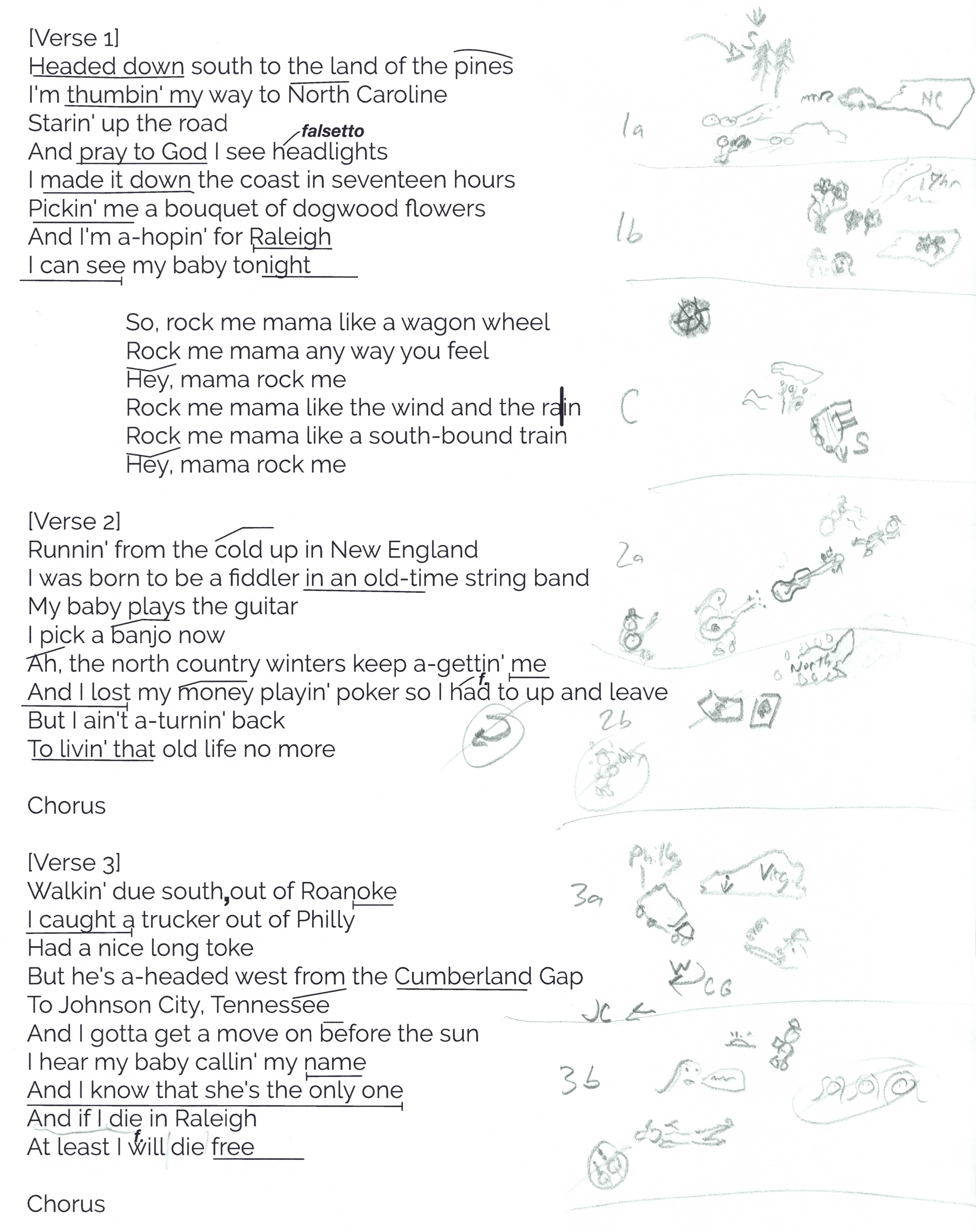
The lyrics annotated with doodles for each line that needs one. Each verse is split up into sections (e.g. 1A and 1B). Only you have to understand your doodles. Don’t waste time being an artist!
When you are done with your doodles, it's time to close your eyes or look at just the doodles and start singing the first verse. If you can remember the first line, great, keep going until you get stuck. Whether you get stuck on the first line or second or third, peek your eyes over at the line you forgot, remember it, and immediately sing it back. Don't worry about singing the line with the right style or timing while you're memorizing. Do this with each line of the first verse until you get through all the lines. Then go back and try to sing the whole first verse again, peeking whenever you forget something. Try both closing your eyes to remember and looking at your sketches, one technique or the other may help more on a certain line. If the song rhymes like this one, pay close attention to the rhyming relationship between two lines in a row, like "pines" and "Caroline". The rhyming relationship gives you an additional aid for remembering either line. Once you have the first verse fairly memorized, even if you have to stop and think before some lines, move on quickly to the subsequent verses. You can save the chorus until the end, since that's usually the part that is more memorable or that you have already learned in the past. Important trick: As soon as you memorize a new verse, sing everything before it and up through it. This keeps the early verses from falling out of memory while you are learning the later verses.
Most song lyrics have unintuitive lines and intuitive lines. For instance, I find that "Headed down south to the land of the pines" is pretty intuitive, because the song is all about heading south from cold New England to warm Raleigh, North Carolina. But "I'm thumbin' my way to North Caroline" could easily be remembered incorrectly as "I'm making my way to North Caroline" since "making my way" is a more common phrase. Whenever you find yourself reciting unintuitive lines like this a bit wrong, just mentally note your mistake so that your brain begins to remember to be careful on each line with an unusual word. In this case we know the guy is hitchhiking, so remind your brain to remember that he is hitchhiking by using his thumb. There might be entire lines that are unintuitive or seem out of context with the other lines. I found that "And I gotta get a move on before the sun" in verse 3 seems a bit arbitrary since there was nothing mentioned about the time of day in the previous lyrics. That means I often have to stop and really think about that lyric to recall it. Once the message of the lyric comes to mind, something about moving in a hurry, I can piece the line together if I recall that it has a pretty cliché phrase in "gotta get a move on".
Like millions of others, I never understood the lyrics “Blinded by the light, revved up like a deuce, another runner in the night” in Manfred Mann’s cover of Bruce Springsteen’s Blinded by the Light. Springsteen’s original version “Blinded by the light, cut loose like a deuce, another runner in the night” isn’t much clearer. Deuce refers to a Deuce Coupe — a '32 Ford Hot Rod.
Make sure you understand the song lyrics as much as possible. If you are singing in your non-native language and don’t understand a phrase, ask a qualified friend or the internet. I was learning a Jimmy Rodgers’ version of Away Out on the Mountain the other day, and he sings “Where the eagles roost on the rocks of spontan”. The problem is that spontan isn’t a word and this was likely a misread by Rodgers, according to internet speculation. Later singers wisely changed it to “rocks of the mountain”. There are also some songs with nonsense lyrics due to mutilated older text. Wildwood Flower’s opening line “Oh I'll twine with my mingles and waving black hair” was the Carter Family’s misinterpretation of and older song: “I'll twine 'mid the ringlets of my raven black hair”. Despite that, we all stick with the incorrect lyrics. What matters is that you understand what you are singing so that it’s easier to remember and deliver convincingly. You can try to remember and sing words that are nonsense to you, but the audience might not come along for the ride.
Recite
If you are playing an instrument while you sing, it's never too early to start playing the chords of the song or throwing in the musical intro while you're memorizing the words. But don't play longer solos or instrumentals until you have the words memorized. If you can't recite a lyric in rhythm with the chord progression, pause playing your instrument until you really have the lyric memorized, then check the recording to see how the chord progression timing works before singing and playing the instrument for that line.
Once you can stumble through the whole song with only an occasional peek at the lines, you're in good shape. Try to practice singing the song as much as possible throughout the day and keep your practice sheet handy so you can check lines you forget and look at markings if you singing a line in the wrong way. If you can't remember how a line sounds, even if you remember the words, crank up the recording and sing along to that part. If you have anyone in your household who is tolerant or even enthusiastic about your singing, let them know you have a new song and try to sing it for them. This bit of performance pressure accelerates the learning process because it will expose the lines that you might have trouble remembering at a real performance.
By day two, you'll already be remembering the song more completely. Keep practicing and consider memorizing a new song. For some reason, memorizing something new seems to help solidify your memory of the previous song you memorized, perhaps because the brain shoves yesterday's lyrics into a more permanent place in memory to make room for the new lyrics you're learning.
Johnny Cash and Lynn Anderson sing a bit of his wordy hit I’ve Been Everywhere, written by Geoff Mack.
Quantity vs Quality
The pace you learn and memorize songs has to do with what your goals are and your experience level. Just like with learning tunes, the advantage of learning large quantities of songs is that you get more experienced at the process of learning and memorizing, and you get more exposure to different styles of song music and lyrics. If you are learning songs in order to play a half-hour gig or to learn the setlist of your band, then you are more likely to focus on quality than quantity.
Lastly, we want to celebrate an ever present quality of playfulness with music making. If you hear a song in your music stream that you love, commit to learning it. Write in on your song list and get a practice sheet created so you can learn and memorize the song as quickly as possible (we’ll discuss both song lists and song practice sheets in next week's post). There is something to be said for the musician who, on any given day, gets inspired to learn how to perform a new song they love. There's a well-known story of Bob Dylan flying Paul Brady to the United States just so that he could have Brady teach him The Lakes of Pontchartrain. Let spontaneous inspiration help you increase your repertoire whenever possible. After all, you never know when you might be sitting around a campfire and that special somebody wants to hear Wagon Wheel!
Happy memorizing!
-Andy Likuski