
Learning & Reviewing Tunes
Bothy Band members play their famous 6 tune set called Rip The Calico from their 1977 Album Out of the Wild, Into the Sun. RIP Paddy Keenan.
There are a lot of tunes to learn! The fact that Irish musicians play them as sets is no accident. It's helpful for playing for long dances and for grouping tunes together so that it's easier to remember a repertoire that quickly reaches thousands of tunes. It's also extremely fun to play along with a set when we don't quite know what the leader has in mind next. Our challenge is to organize an ever growing list of tune sets and to find a reliable way to review them all sequentially so that we reinforce our memory of each tune. We actually need to do quite a few tasks.
We need to:
Learn a new tune note by note, phrase by phrase, line by line, and part by part
Learn to play that tune at a reasonable tempo
Play the tune as part of a set and switch gracefully between tunes
Recognize and remember how to play a tune we hear
Remember how to play the tune when we hear the name said
Practice all of our sets regularly to retain them and improve
Wow, sounds like quite a chore list. Luckily, we are doing something that we love, playing Irish tunes at home of with our friends, and we get to enjoy steady improvements to our musicianship in the process. Here's how we're going to tackle this challenge in the most fun and efficient way possible:
Create your ever-growing tune set list
Get exposed to tunes and learn a new one regularly from a teacher
Learn to play that new tune at a reasonable tempo
Find a set with one or more other tunes to put the new tune in
Understand the tune’s key and some chords that can back the tune
Make a backing track for each tune in the set and create a backing track medley (you can use a metronome instead of backing tracks)
Make a tune set practice sheet for the tune set.
Practice the set to the backing track a lot at first then regularly along with your other sets.
Are you now excited to organize your acquisition and practice of tune sets?!! Well maybe not quite yet, but bare with me and give this process a try. The investment will pay off.
Your Tune Set List
Lists quickly grow out of control take a bit of organization.
Let’s inventory all the tunes you know, which could be anywhere from zero to quite a few. You want everything you plan to have in your repertoire documented to make sure that it is in your practice rotation. This doesn’t mean you are going to choose to lead the playing of all these tunes as sets at a session. It means you know how to play the tune set and can have it in your lead-ready list (green) or your follow or lead-testing list (yellow). If you haven't learned some or any tunes, you put it in your learning list (red). If there are tunes you simply hate, either leave them off the list and sit them out at jams or list them in case you are forced to play them. Most musicians I know dislike certain tunes because they are overplayed, cheesy, or just hard to play on a particular instrument.
Your first digital document is an organized rich text list of the tune sets that you play. The document should have basic layout options like indented numbered outlines and various heading sizes. Any modern document like Google Docs, Microsoft Word, Apple Pages or a wiki page supports this. Don’t get hung up on your choice of technology. You can always copy-paste to a different system in the future. Digitally write down every tune that you know or have ever tried to play. If you don't have any, start with one of these (the key of each tune is in parentheses)
Example
Lead-Ready
2026 Reel Sets ← Instead of year, you could categorize by animal 🦒, color 🟣, etc.
Anderson's, Father Kelly's "A very old pair of tunes" ← Mental association you have with the tune set
….
2025 Reel Sets… ← Previous year or animal, color, etc. sets
2026 Jig Sets…
….
Follow or Lead-Testing
2026 Reel Sets:
The Sally Gardens (G), The Maid Behind the Bar (D) "Heard at the session in March 2026"
Jackie Coleman's (D), Pigtown (G) ← red for unlearned tune of a medley
?, The Old Bush (D), ? ← ?s indicate a tune that doesn't have a medley yet
…
2026 Jig Sets …
Learning
Reels: ← No year or category here, since we don't know when they will be learned
The Floating Crowbar (D), The Star of Munster (Amin)
Jigs:
Tripping up the Stairs (D), The Old Favourite (G), Cliffs of Moher (Amin)
Hornpipes:
The Harvest Home (D), Boys of Blue Hill (D)
…
It's important to organize the tune sets by tune type–reel, jig, hornpipe, slip jig, etc. Try to think about tunes in medleys of 2 to 4 tunes. If you learn a tune and don't have a medley for it yet, place it by itself or find another tune that is often played with that tune to learn later, mark tunes you don't know yet in red. By the way, some long tunes can be played without medleys, such as the Strayaway Child, which has 6 parts. In addition to organizing sets by tune type, we further categorize them to give the tune sets a little more context. The most obvious categorization is by year, but categorization alternatives like colors and animals might be more effective for your brain. I use animals by including emojis, such as 🦔 Hedgehog Reel Sets, and choose a new animal category when either my reel or jig set list reaches about ten sets for that animal. The less common types like hornpipes and slip jigs will naturally have fewer sets for each animal.
Once you've created your tune list, make sure to store it in a file on a cloud service so you can access it from any device and optionally share the evolving list with friends.
Tune Exposure and Learning
Being introduced to a tune and getting to know it is fun! You might hear it once at a jam and want to learn it right away or acquiesce after it's played a dozen times and forced down your throat. You might alternatively get a tune from your teacher or simply hear it in a music stream. It can be useful to write down your origin story for acquiring a tune. You can do this with a note in your tune list, such as Trip to Durrow, Temperance reel, The Maid Behind the Bar "Heard this set at the session in March 2026" or "Played this set in a session at Feilé So-And-So in 2025".
Now that you are equipped with your digital tune list sitting in the cloud, it’s time to dig in and organize your learning of each tune. We're not practicing quite yet, but we are indeed learning. Let's dub this "housework". If you have lots of tunes, do the following housework in the order in which all of your tunes are listed. Do this work as you get to practicing a tune or tune set for the first time.
Every time you learn a new tune, you are learning part by part (A, B, etc). Within each part there are usually 4 lines where each line is 2 phrases. Longer set dances are a typical exception. You want to learn each tune from a teacher, either in-person, by video call, or from a prerecorded video of a teacher. Using an album recording is also an option for more experienced musicians, but only if you understand enough about your instrument to know what you are hearing.
Tune Structure
Let’s use the Temperance/Teatotaller's reel A part as an example. The A part has 4 lines.
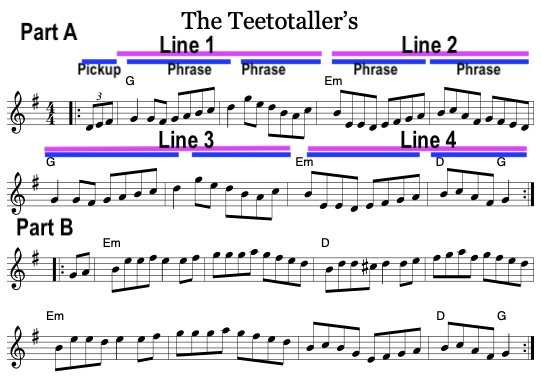
Source: https://thesession.org/tunes/114. You’ll find the meta-data about the the tune type and key as well letter notes by clicking the ABC tab on each posted version of the tune. Posting chords is optional.
T: The Teetotaller's
R: reel
M: 4/4
L: 1/8
K: Gmaj
Pickup: Like many tunes, Line 1 of this tune is preceded by a pickup into the tune, a little triplet. If you count in the song out loud, you might count 1 (two beats), 2 (two beats), 1, 2, 3 then tri-pel-et–where tri-pel-et is you playing D, E, F# on the 4th beat of the count-in before landing on a G as the first official note of the tune.
Lines 1 and 2: Line 1 starts with notes over a happy G major chord that progresses to the darker E minor (Em) chord of the Line 2.
Lines 3 and 4: Line 1 and 2 are nearly duplicated in Lines 3 and 4, but 4 resolves back to G via D. Tunes nearly always resolve to the chord of the key they are in at the end of each section, though there are exceptions when the resolution is delayed until the start of the next part.
Phrasing: If we dig a tad deeper, we discover that Line 1 of Part A has two distinct phrases, where a phrase is a logical sequence of notes separated by some pausing note. The first phrase in this tune is the main chunk of Line 1, and the second is a transition into Line 2. Occasionally in tunes, a phrase will bleed over into the next line, but these folk tunes are usually pretty straight forward and the phrases tend to end whenever a line ends or before a pickup into the next line. A phrase is not the same thing as a measure (the vertical bar-separated sections). Notice that in our tune the first phrase ends in the second full measure (on a D). For the second two phrases, there is no pause between them but the change to E minor (Em) serves as the end of one phrase and the start of the next.
Your teacher will normally teach you a tune line by line or phrase by phrase. Encourage your teacher to play a whole line for you to repeat so you only have two learn 4 lines instead of 8 phrases. If the line is too hard, have your teacher split it into 2 phrases, but never learn anything smaller than a phrase. As you learn to play aurally, your brain will get better at hearing and repeating an entire line.
Identify the tune with an online resource
In order to identify the tune type, key. and possibly even backing chords for the tune, it helps to use an online database of tunes for your genre. For Irish music you can use the session.org and TunePal. TunePal is a cross genre tune app that lets you play your instrument, sing, or play a recording into it, and it will use pattern recognition to identify the tune and point you to sheet music sources, which it can play as MIDI.
☘️ The type of tune and its time signature
Irish tunes have several tune types that usually correspond to a single time signature. Reels in 4/4 time (4 quarter or 8 eighth notes per measure) and jigs in 6/8 (6 eigth note beats per measure grouped into 2 sets of 3), hornpipes (counted as a swung 4/4 or 2/4 rhythm), marches (usually 4/4 but sometimes 6/8), polkas (2/4), slides (a fast jig), slip jigs (a 9/8 jig), slow-airs (slow 4/4 tunes), and waltzes (slow 3/4 tunes) make up the bulk of the repertoire.
Finding the key the tune is in
If you are learning a tune from a teacher, they will always give you the key it is played in. If you are picking up a tune yourself, it's worth learning how to identify the key with a repeatable series of steps.
Check out those #s and♭s
Learning to hear what key a tune is in is a matter of procedure, not magic. If you want a short cut, look up the tune online on The Session or TunePal. These sites will tell you the key or show sheet music with the key signature. If you can't read key signatures, you can find a cheatsheet online (e.g. https://www.piano-keyboard-guide.com/key-signatures.html). Tunes are occasionally played in multiple keys, so you might find sheet music versions with different key signatures. In this case, you'll want to pick the key that matches the recording track you like or ask an experienced musician what key they play the tune in.
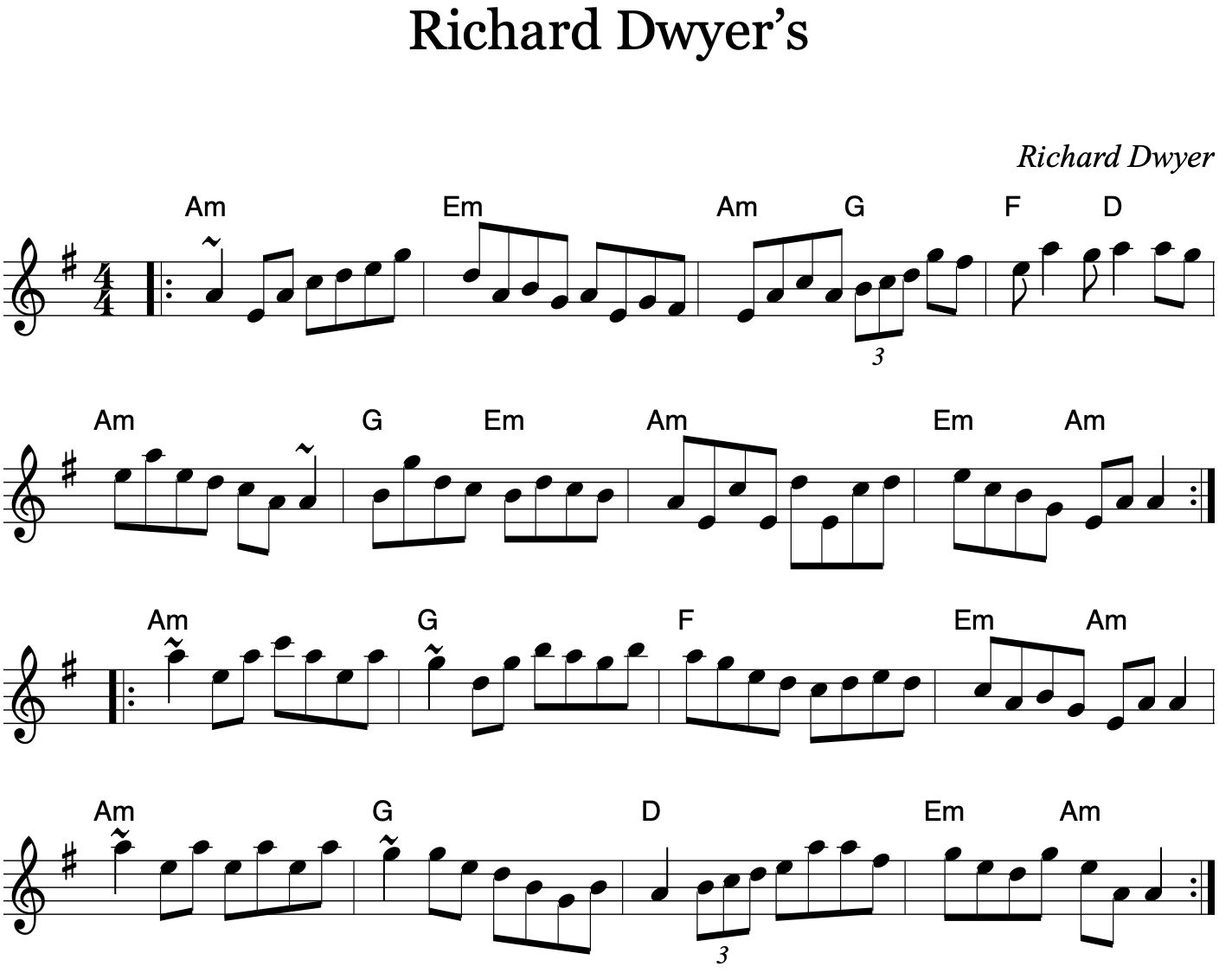
T: Richard Dwyer's
R: reel
M: 4/4
K: Ador
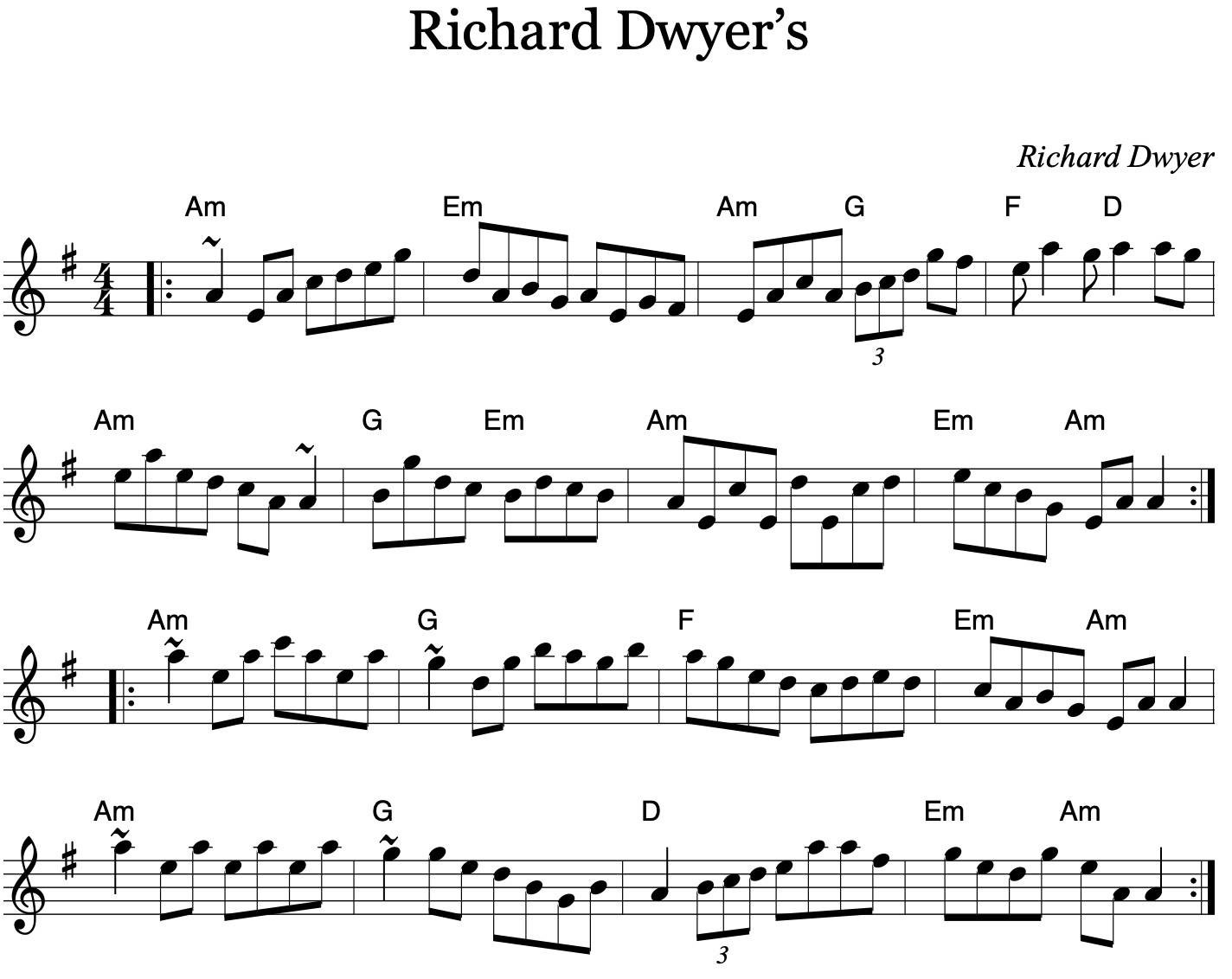
The tune Richard Dwyer's in Amin, one of multiple tunes of this composer, has at least one sheet music version with chords and a useful summary on thesession.org at https://thesession.org/tunes/1131:
The sheet music is basically enough to tell you that this is an A dorian tune. The F# in the key signature (the first # at the beginning) tells us that this is the key signature of G major, D mixolydian, E minor, or A dorian. That combined with the tune starting and ending with an Amin chord and note says definitively that of the four possibilities, the key must be A dorian. The summary information K: Ador confirms it. For more information about straight major and minor keys versus the modal mixolydian and dorian, see the section What kind of "mode" are you in? below.
Tuning in to a recording
🎧 You can also figure out the key of the tune by playing along with the tune on your instrument. Here it's wise to slow the tune recording down. You can most easily do this by finding the track on Youtube and then using the Chrome Transposer Plugin. The notes you play along with on your instrument can usually help you resolve the key of the tune. The most important thing is what note the tune resolves on, meaning the last note of the tune. Usually, but not always, each section of the tune will end on the note that is the key of the song, and you will hear something that sounds like a resolution, rather than a note with tension that is not yet resolved.
What kind of "mode" are you in?
Once you establish the resolution note that indicates the key, you need to find out if the tune is major, minor, or something in between–a modal. It might be easy for you to hear the difference between major and minor. To most, major sounds happy and bright., whereas minor sounds sad and dark. If you don't have this ability, or the tune sounds ambiguous, you'll need to learn the most basic of music-scale theory.
From brightest to darkest, folk tunes in our genres will generally occur in four different modes. I'll use a C scale to demonstrate people with piano backgrounds, but the same intervals apply to any note's scales, such as G or D.
The following uses a tiny bit of music theory, but don't be intimidated if you don't know theory. We're simply demonstrating a scale of 7 distinct notes with 0 to 3 flats depending on the mode of the scale.
Standard major scale (ionian)
This is the brightest and happiest scale likely to occur (lydian scales are even brighter and have a sharp 4th, like the first line of some versions Greensleeves).
Example major reels C: The Lilting Fisherman, D: The Maid Behind the Bar
C major (0 flats):

The standard major sounds happy.
1st (root) C
2nd D
3rd E
4th F
5th G
6th A
7th B
1st (root) C
Mixolydian
Less bright, more bluesy
Example mixolydian reels: C: Paddy Fahey’s (#27), G: The Girl Who Broke My Heart, D: The Old Bush
C mixolydian (1 flat):
Mixolydian is less bright, more bluesy.
1st (root) C
2nd D
3rd E
4th F
5th G
6th A
flat 7th B♭
1st (root) C
Dorian
A bit dark, but more moody than sad.
Example Dorian tunes: Am: Sliabh Russel (jig), Em: An Paistin Fionn (hornpipe)
C dorian (2 flats):

Dorian is a bit dark, but more moody than sad.
1st (root) C
2nd D
flat 3rd E♭
4th F
5th G
6th A
flat 7th B♭
1st (root) C
Standard minor scale (aeolian)
Dark and sad. (There are darker modes called phrygian with a flat 2nd and locrian with a flat 2nd and flat 5th, neither of which ever occur in our folk genres).
Example minor tunes: Am: Castle Kelly (reel), Em: The Butterfly (slip jig)
C minor (3 flats):

The standard minor is dark and sad.
1st (root) C
2nd D
flat 3rd E♭
4th F
5th G
flat 6th A♭
flat 7th B♭
1st (root) C
Finding or creating a backing track (optional)
Unless you prefer playing by metronome, the next step is to make a backing track of the tune’s chords. Backing tracks usually revolve around a guitar strum and optionally other instruments. I like making a backing track because figuring out the chords teaches me about the tune. It also keeps me more engaged when practicing a tune over and over than the metronome does. However, the metronome can be more useful when practicing complex passages that require careful timing. If you are using Strum Machine, you can toggle a metronome on and off along with the backing instruments based on what you need. I’ll assume you're using Strum Machine, but feel free to try other backing track apps. Follow these steps to make a backing track. We'll use Richard Dwyer's in Amin again as an example:

Strum Machine free trial.
If you don't have Strum Machine, create a free trial here. You don't need to give a credit card so you won't be charged anything. If you want to keep Strum Machine after 14 days, the cost is very reasonable.

Strum Machine search or add new song.
2. Search for your tune in Strum Machine. If it exists, I recommend saving a copy to one of your lists. If your tune doesn’t exist, hit the New Song button in Strum Machine and write in the tune’s name. If this is your first tune, create a new list such as "Irish".

Choose the key, time, and backing style.
3. Find the type (e.g. reel or waltz) of tune and its time signature from an internet resource. Enter the key signature in Strum Machine. Standard time in Strum Machine is both 4/4 and 2/4, so leave the time signature alone if the tune is in 4/4 or 2/4.
4. Find the key the tune is in, as we discussed above.
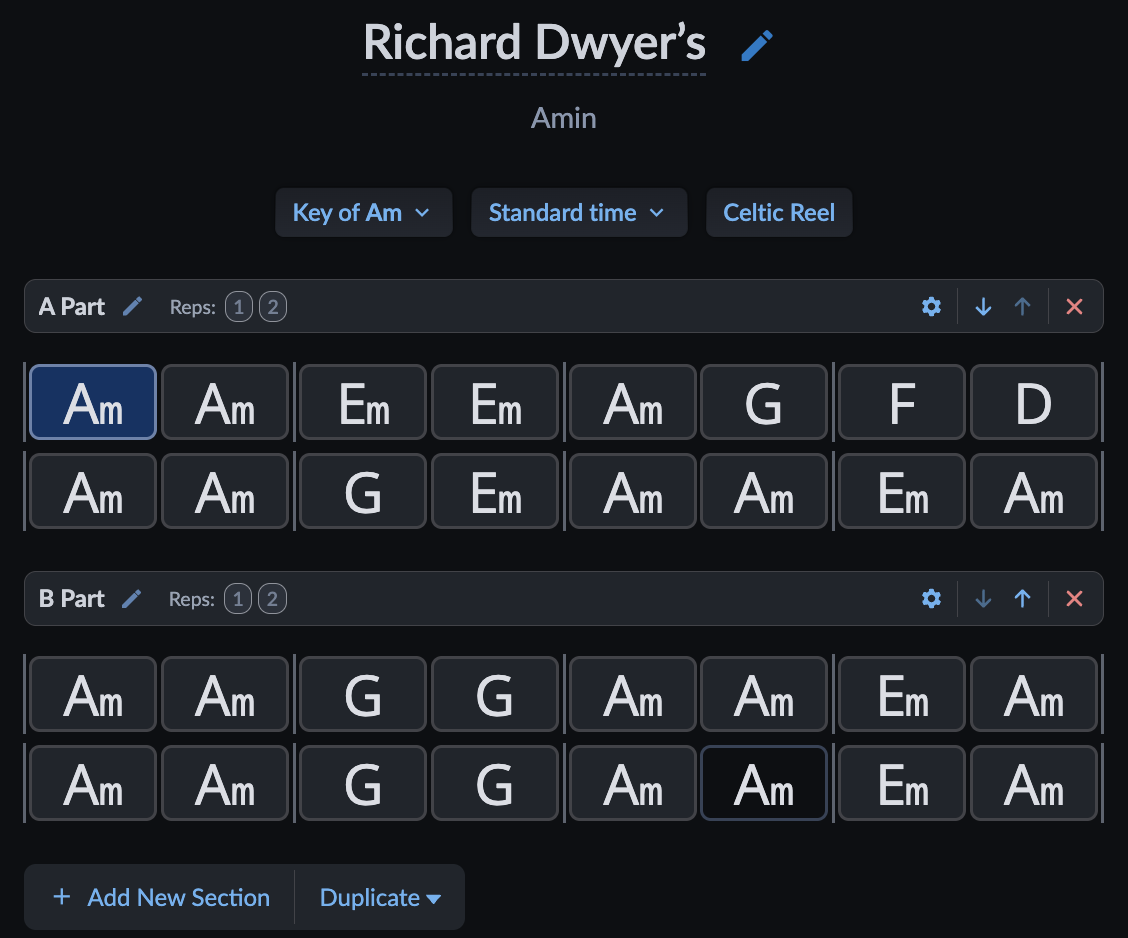
Chords completed on Strum Machine.
5. Create the chord chart for each tune part. Label the parts A Part, B Part, etc. In Strum Machine, each box represents 2 beats in 4/4 time, 1. beat in 2/4 time, or 3 beats in ¾, 6/8, and 9/8 time. Chords are often available now on the session.org. If they aren't, listen to the recording and try your best to figure them out or ask a friend who can hear chords. Don’t fret over getting the chords just right, but make sure that you have the correct number of beats in each section. When you are practicing the tune with the backing track later, you can always stop and edit the chords if something sounds wrong. I tend to avoid entering fancy chords like 7ths and those with alternate base notes. If you feel they are fundamental to playing along, enter them.
Note that for reels, a measure of Amin above corresponds to two boxes in Strum Machine. This is because 1 box in Strum Machine is 2 of 4 beats in a measure, so 2 boxes make a whole measure. In measure 3 above, we see an Am and G in 1 measure, so we give each of these a box in Strum Machine. Strum Machine can also do 2 chords per box if there are more than 2 chord changes in a measure. For the second part of the tune, I've entered simpler chords in Strum Machine than the sheet music because I like the way it sounds better. Feel free to enter the chords that sound best to you.
6. Validate the chord chart. I do this by humming, singing, or playing the tune notes whilst the backing track is playing. Once everything seems good enough–not necessarily perfect–hit, save.
7. Hit play to play the backing track while playing your instrument. If something is wrong, simply edit the backing track and change it.
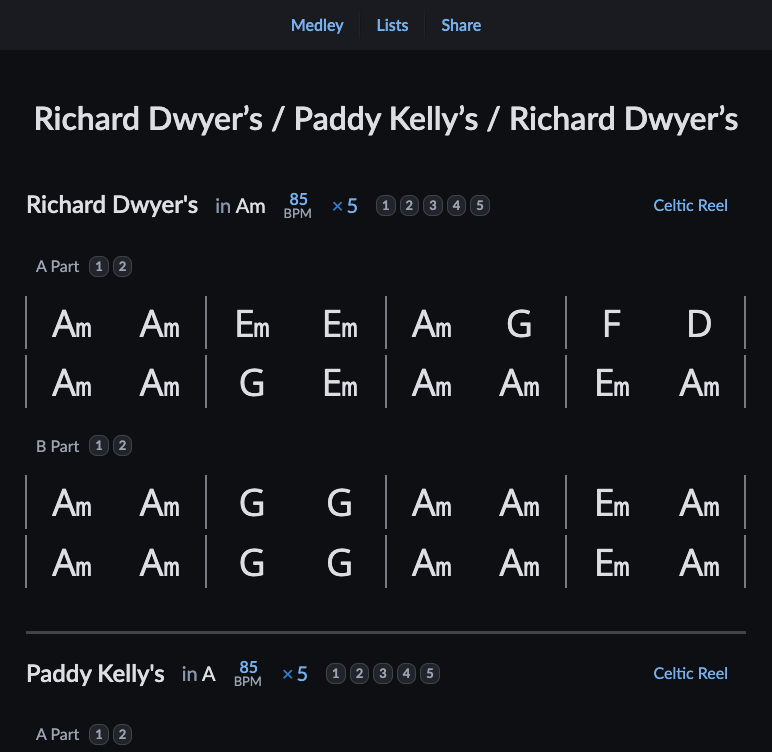
Create a medley with a few tunes. (This medley has 3 tunes, the first and third are different tunes with the same name.)
8. Once you have a whole tune set complete in Strum Machine, you can make a medley. You can choose how many times each tune plays and the tempo of the medley or individual tunes.
9. Hit the play button in Strum Machine and practice the Medley!
Tune Practice Sheet
Next to the music and instruments themselves, practice sheets are probably my favorite part about practicing music. Imagine in a document for each tune set or song that you want to perform, curated with love by you.
Does that sound like some kind of sick joke?
To love practicing and to do the work of making practicing easier (read this book by Edmund Sprunger) and ever more fun are in fact our goals. Practice sheets give each piece of music you want to learn and maintain a logical process that is repeatable for hundreds of pieces.
Tune set practice sheets consist of the following:
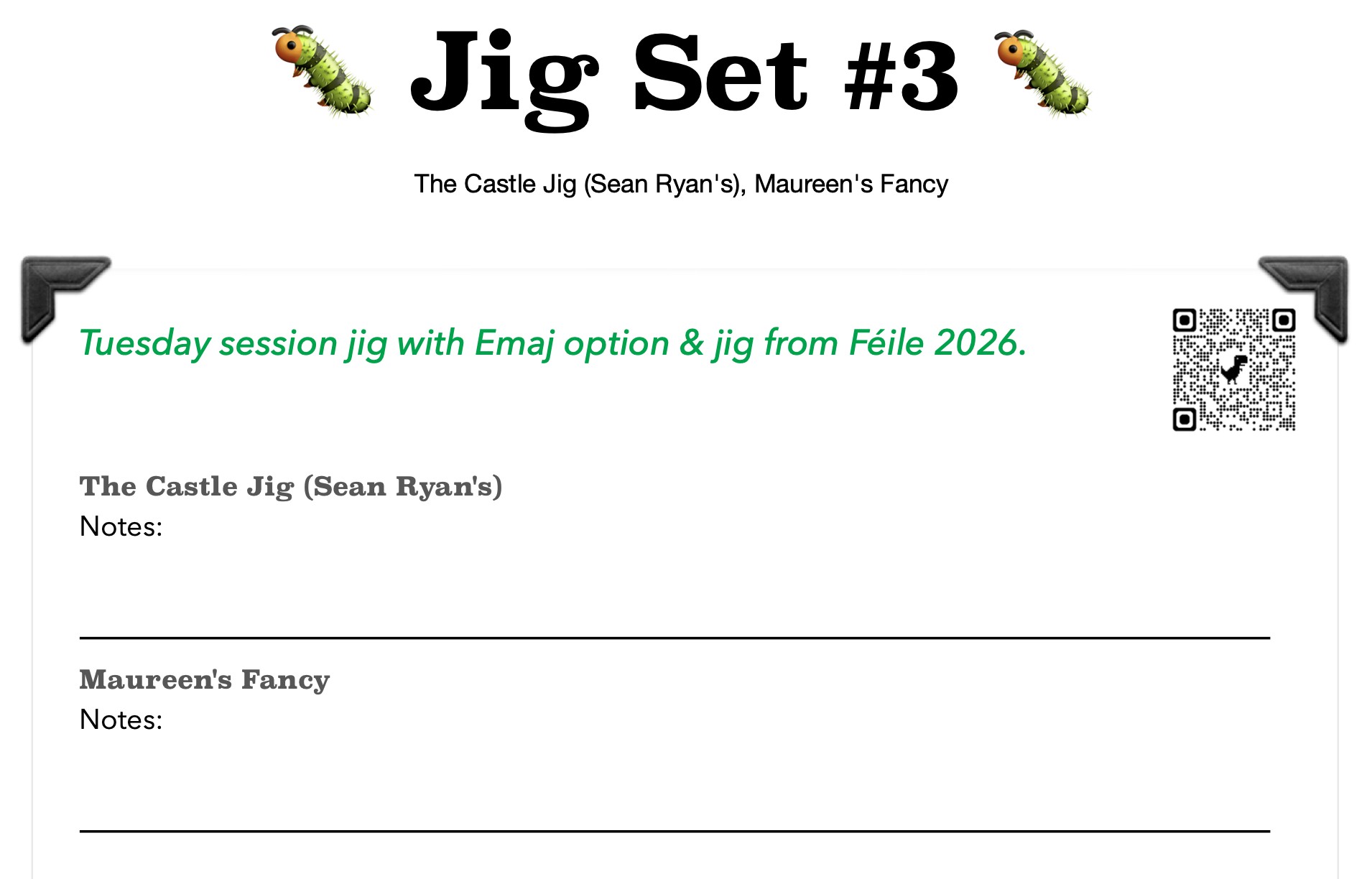
A sample tune set practice sheet.
The type of tune and a heuristic way of ordering the tune set relative to others. Use years, animals, colors, etc. As mentioned, I use a system of animals, so my first reel set was Hedgehog Reel Set #1, followed by #2 and up to 10 or so, after which I moved to a new animal, Sheep Reel Set #1.
The list of tunes in the set
The association I have for the set. In this example, I simply combined a tune I heard at a session with a tune I learned a féile
A QR code to my Strum Machine backing track. (Follow these instructions to quickly make a QR code with Google Chrome.)
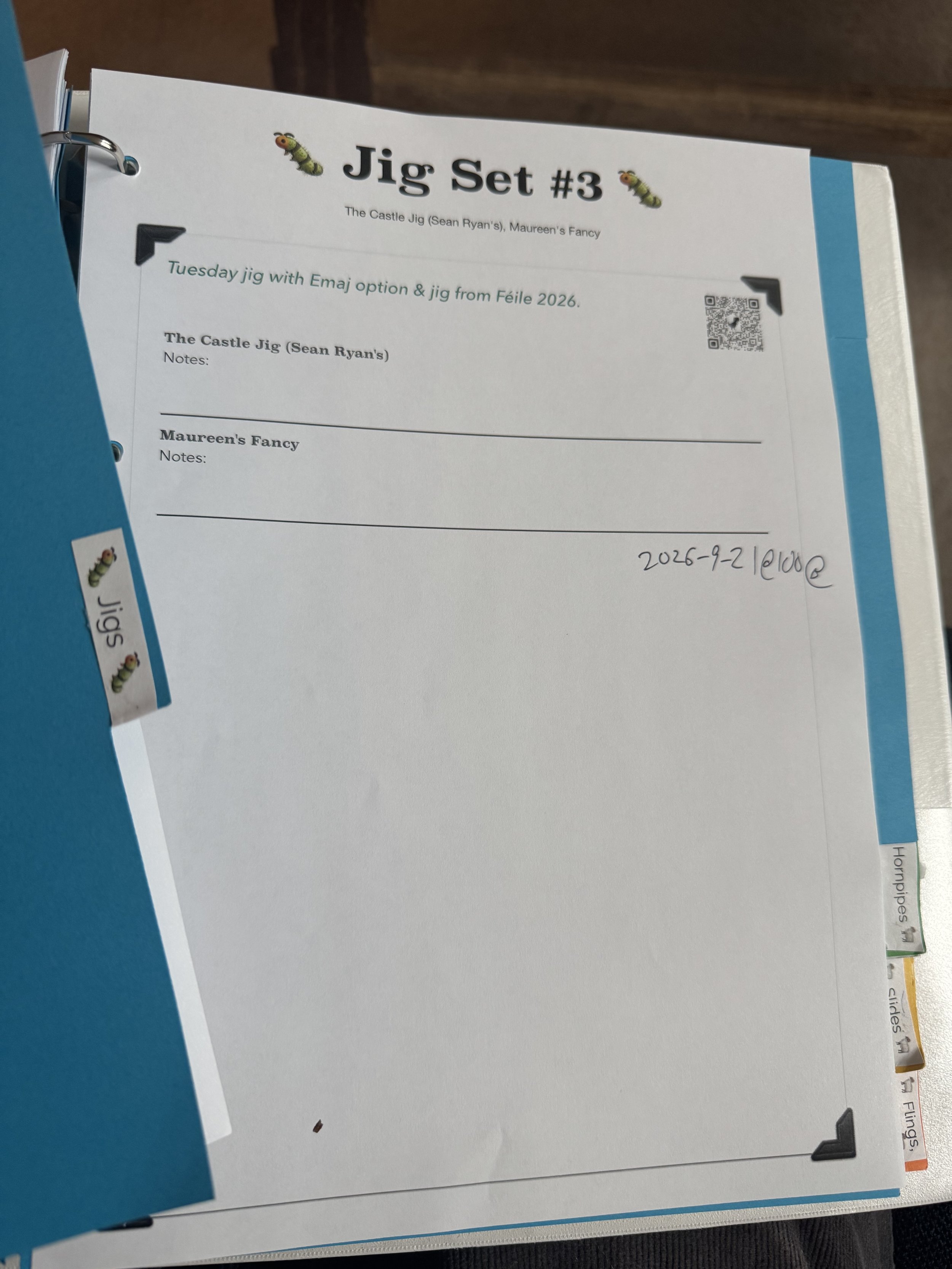
My practice sheet binder.
I print my practice sheets out and put them in a binder organized by tune type and category, so this example would be the third page in my caterpillar jigs section!
Each time I practice the set, I write the date, the tempo and my grade (A through D). When you are practicing sets from your tune sheets, you can simply go chronologically through your digital or physical binder and start over when you get to the end. You’ll naturally always be learning new sets, which get priority learning, over those in the binder. Those new sets will then find their way in the binder and be reviewed chronologically later.
As I mentioned in a previous post, don’t forget to record your practices. I recommend taking a video of yourself playing while you have the backing track playing in headphones. This allows for the recording to pick up just your playing and for you to hear the backing track while you play.
Conclusion
There’s a lot of housework that goes into maintaining your tune list, backing tracks, and practice sheets, not to mention the thousands of hours of practice. I hope I’ve given you a bit of structure for learning and practice the great opus of work that is Irish trad tunes. Being organized can be intimidating, but the reward is much more efficient practice where you don’t forget to practice the tune sets you’ve already learned. This system also gives you a fun way to practice with backing tracks or a metronome where you can log each practice of the tune set right on your practice sheet and track progress in terms of playing at high tempo and quality.
Happy organizing!
—Andy Likuski