
As folk musicians playing tunes and instrumental solos, we sometimes need to slow it way, way down. I don’t mean just our own playing, but also the recordings we are trying to learn from. Thanks to modern free internet technology, we can slow down recordings and loop the sections that we are learning down to a single note or that tricky triplet that you just can’t figure out at full speed. I’m going to demonstrate the wonderful free Google Chrome plugin Transpose, which lets you slow down media like YouTube videos, loop sections, and transpose tunes to better keys and songs to match your singing voice.
Let’s take a classic look at the class Eavesdropper album by Kevin Burke and Jackie Daly, specifically The Fairy Reel on track 9. Here’s the video:
Kevin Burke and Jackie Daly play The Fair Reel on their Eavesdropper album.
I’ve set the embedded video to start at the beginning of The Fairy Reel. Now, I generally recommend learning tunes directly from a teacher, but you might find yourself in a position of wanting to learn a certain artist’s version of a tune or learn a tune that your teacher doesn’t know. Let’s pretend that we are learning The Fairy Reel by ourselves.

The Transpose Plugin icon
When you start listening to The Fairy Reel, you will notice that line two has a quick triplet that is hard to distinguish at full speed. You can use the Google Chrome Transpose plugin to slow the track down. To set this up, make sure you are using Chrome for your browser. Install the Transpose plugin. Once it’s installed, you’ll see this little yellow and black icon in your browser toolbar. Now reload the YouTube video and click on the Transpose icon to reveal the controls. You’ll see a Transpose and Pitch slider, which are useful if you want to learn a song in a different key or want to change a recording in E♭ to D. Below that is the speed slider, so you can slow the tempo of the track down as much as you want. You can also loop part of the track if you’re trying to decipher certain notes or play along with a passage.
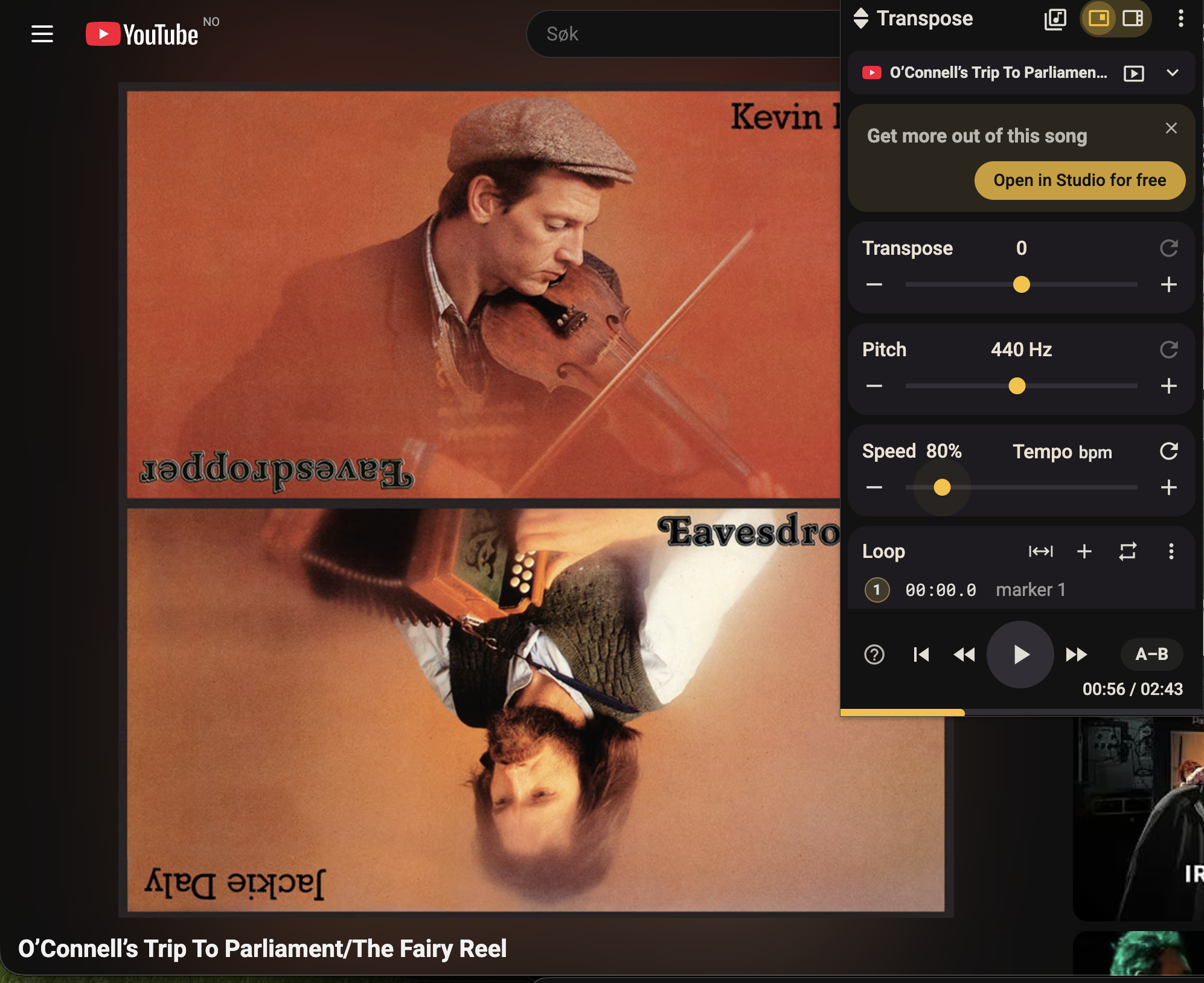
Using the Transpose plugin with the Eavesdropper album.
Here’s a clip of the second line of the Fairy Reel at full speed with the triplet. It’s pretty tough to distinguish those triplet notes.
Now let’s slow the speed down to 50% with Transpose and hear it again. That’s a bit easier to hear! You’ll lose some audio quality as you slow down the track, but it’s worth it for distinguishing the notes of a difficult passage or learning to play along to a fast track.
Da Dannan was a band that always played instruments tuned to E♭instead of D. Here’s a video demo of their version of Johnny Leary’s Polka where I change the track from E♭ to D using the Transpose slider so that I can play along in a normal key. I also also slow down the tempo and then create two time bookmarks and loop the track between those two bookmarks.
Da Dannan playing Johnny Leary’s Polka with use of the transpose and speed sliders and the looping feature of Transpose.
One of the great things about slowing down a line or phrase is that you can really dig into what makes an artist groove. We often default to playing tunes straight when in reality artists push or hold back on notes against the beat to give the music it’s distinct Irish feel. When you slow the track way down, you might hear the music as a bit swung, meaning the first 8th note of each pair is held slightly longer than the second. Or it might be that the emphasis on a certain beat is what makes the music sound swung. Don’t be afraid to use up some time analyzing music at slow speeds and playing along. I find that hearing and copying phrases slowly makes the music easier to play at full speed because my playing imitates the natural “breathing” of the tune, by which I mean the swells and subsiding of tempo or accentuation in each phrase. Sometimes playing everything straight without phrasing is a bit like playing with your instrument’s breath held. You’ll eventually speed up or fumble as you because you’re not following the “breathing” pattern of the tune. Of course, you should also be mindful of your actual breathing as you play.
The first part of The Reel of Rio (aka The Road to Rio) by Brian Rooney at 50% tempo.
Here’s an example of a tune played at 50% speed, The Reel of Rio (aka The Road to Rio) by Brian Rooney. Notice how the fiddle emphasizes the first and third beat along with the foot tap, making those two 8th notes actually feel a bit longer and thus creating a swung sensation. Now listen at full speed. You can still hear the fiddle’s emphasis, but you probably wouldn’t have noticed it if you had only listened at full speed.
Try listening to one of your own favorite tracks at a slow tempo. Listen to the melody instrument(s) for notes that are delayed or landing a bit before the beat, and listen for emphasis. Then try playing along, gradually speeding it up to the highest speed you can comfortably play at. Finally, turn off the recording and play alone. With time, I think this process will make us feel more locked into tunes and sound more authentic.
—Andy Likuski